


Eyeshadow: A Complete Guide to Colors, Types, Techniques and Application
 Khizrana Begum
Beauty & Lifestyle Writer
Khizrana Begum writes clear and reader-friendly content covering beauty, lifestyle and related topics.
Read Full Bio of Author →
Khizrana Begum
Beauty & Lifestyle Writer
Khizrana Begum writes clear and reader-friendly content covering beauty, lifestyle and related topics.
Read Full Bio of Author →
 Sameena Begum
Health, Technology & Digital Content Reviewer
Sameena Begum reviews content for clarity, accuracy and overall reader usefulness.
Read Full Bio of Reviewer →
Sameena Begum
Health, Technology & Digital Content Reviewer
Sameena Begum reviews content for clarity, accuracy and overall reader usefulness.
Read Full Bio of Reviewer →
Eyeshadow has the potential to completely transform your appearance, whether it is for daily use or dramatic eyeshadow for a night out. There are numerous colors, finishes, and techniques, which makes choosing and applying eyeshadow very daunting at the beginning.
This article will introduce you to all the basic information about eyeshadow and include its types, finishes, colors, techniques, and application tips.
What is Eyeshadow?
Eyeshadow is a cosmetic product used on the eyelids and the surrounding skin of the eye. It helps to add color, create a look, and brighten the eyes. It can be used for creating either simple or more complex makeup looks.
There are different types of eyeshadows, which are powder, cream, liquid, stick, and pencils. While some of them have colors for everyday wear, others have glitter in their composition. Simple looks can consist of just one color, while complicated looks need more colors.
Different Types of Eyeshadow
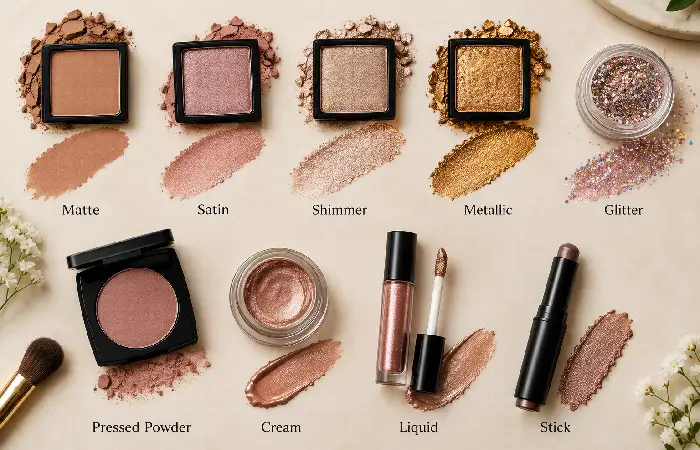
Eyeshadows differ mainly by formula, texture, and how they are applied.
| Type | Description | Best For |
| Powder | Traditional pressed or loose formula | Beginners and everyday makeup |
| Cream | Soft, creamy texture | Quick application and smooth looks |
| Liquid | Fluid formula with strong pigmentation | Bold or precise looks |
| Stick | Eyeshadow in a pencil-like format | Fast and convenient application |
| Loose Pigment | Highly concentrated powder | Intense eye looks |
| Pencil | Eyeshadow in pencil form | Simple application and smoky effects |
Powder eyeshadows are among the easiest options for someone new to makeup application because of their ease of building and blending.
Cream or liquid eyeshadows offer better pigment payoff and come in handy where quick and easy application is needed.
Eyeshadow Finishes
The finish of an eyeshadow influences the final result in terms of how it looks under various lighting conditions.
| Finish | Appearance | Suitable For |
| Matte | Flat with little or no shine | Everyday and crease definition |
| Satin | Soft, subtle sheen | Natural and polished looks |
| Shimmer | Noticeable reflective particles | Parties and evening makeup |
| Metallic | Strong reflective finish | Glamorous looks |
| Glitter | Visible sparkle | Festive and dramatic makeup |
| Frosted | Bright, reflective appearance | Statement eye makeup |
Matte or neutral colors should be selected for transition purposes, while glitter or metallic colors can be used at the center of the eyelid to create a three-dimensional effect on the eyes.
Choosing Eyeshadow Colors
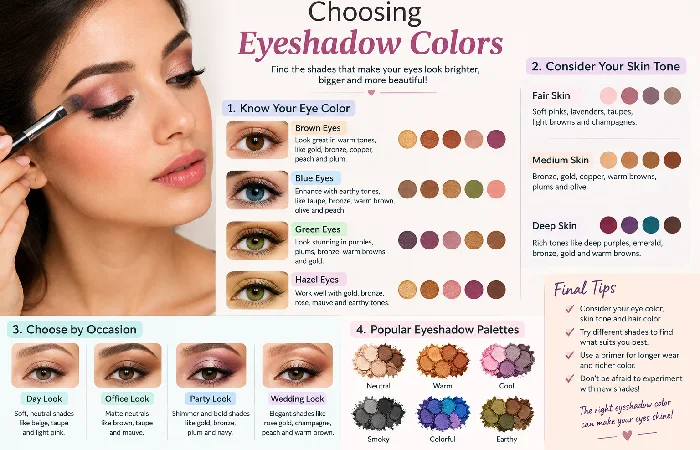
There are many aspects like fashion trends, skin tone, eye color, dress, and occasion that affect the choice of eyeshadow colors for an individual. There is no need to follow any strict guidelines when choosing the colors.
Consider Your Eye Color
| Eye Color | Shades You Can Try |
| Brown | Bronze, gold, plum, copper, brown |
| Hazel | Green, bronze, gold, warm brown |
| Green | Plum, mauve, rose, copper |
| Blue | Brown, bronze, peach, warm copper |
| Gray | Silver, charcoal, mauve, taupe |
Neutral colors are beige, brown, taupe, bronze, and soft gold, which can be used regularly for applying makeup.
For creating an eye-catching makeup look, you may use contrasting colors or deep shades of the colors you like.
How to Apply Eyeshadow Step by Step
It is not necessary to have a lot of makeup products for eyeshadow.
Step 1: Prep Eyelids
Eyelids should be clean and dry. You should find a good primer if your eyelids tend to become oily.
Step 2: Base Shade
Use the lightest neutral shade to cover the eyelid area. It will be the base of the colors that you will use.
Step 3: The Transition Color
Take a medium shade color that is also matte and place it in the crease. Do it using a fluffy brush with windshield-wiper or round motions.
Step 4: Give It Depth
You can take a bit of a darker shade and apply it in the outer corner of the eye. Most of the darker shadow will be on the outer side of the eye.
Step 5: Lid Color
You should use your main eyeshadow shade. If you are applying a shimmery or metallic Shadow, gently pressing the product onto the lid may yield greater payoff.
Step 6: Highlighting
A little of a lighter shade may be applied to the inner corner or brow bone, if desired.
Step 7: Blending
Blending is accomplished with a clean blending brush.
Step 8: Finalize Eye Makeup Application
Eyeliner and mascara may be added to further define the look.
Basic Eyeshadow Techniques
Different techniques create different effects.
| Technique | How It Works | Result |
| One-Shadow Look | Use one shade across the lid | Simple and quick |
| Three-Color Look | Combine light, medium, and dark shades | More dimension |
| Cut Crease | Define the crease with a sharper edge | Structured appearance |
| Smoky Eye | Blend progressively darker shades | Soft, dramatic effect |
| Halo Eye | Place darker shades on inner and outer corners | Center-focused look |
| Outer-Corner Definition | Concentrate depth on the outer corner | Defined eyes |
Beginners should first try single shadow or triple color looks, and then experiment with other makeup tricks.
Eyeshadow for Beginners
When starting out with eyeshadow makeup, you don’t need an enormous palette. Just start with three or four complementary colors.:
- A light neutral shade
- A medium matte transition shade
- A darker brown or neutral shade
- A shimmer shade, if desired
These are the three brushes that make up the minimum collection for applying eyeshadow: flat eyeshadow brush, blending brush, and detail brush. Always begin with small quantities of the eyeshadow and gradually build its quantity. It is always easier to add more eyeshadow instead of removing the extra amount.
How to Blend Eyeshadow
Blending is the most critical part of eyeshadow application. Proper blending will allow smooth transitions between colors instead of distinct patches. A clean or slightly loaded fluffy brush should remain used for blending with small motions.
Tips for Better Blending
- Always start with a small portion of the product.
- Add color gradually.
- Hold darker shades in a concentrated manner on the necessary areas.
- Softening edges requires a clean brush.
- Do not press too hard with the brush.
- Blend only the edges, but do not move the entire color patch back and forth.
Your eyeshadow becomes muddy when there are too many colors used or applied in large quantities.
Common Eyeshadow Mistakes to Avoid
Even simple mistakes can affect the final result.
| Mistake | Why It Can Be a Problem | Better Approach |
| Using too much product | Makes blending difficult | Build gradually |
| Skipping preparation | May affect application | Start with clean eyelids |
| Poor blending | Creates harsh lines | Use a fluffy brush |
| Too many colors | Can make the look appear muddy | Start with 2–4 shades |
| Applying dark shadow too far | Can change the desired eye shape | Concentrate it carefully |
| Using dirty brushes | Can mix colors unintentionally | Clean brushes regularly |
| Matching every color exactly | Can make the look less dimensional | Combine complementary shades |
The other mistake is to pay attention solely to the eyelid and not to the gradation of colors. Usually, soft blending makes the largest effect.
Most Frequently Asked Questions About Eyeshadow
Should I put eyeshadow before foundation?
There are people who prefer to apply eyeshadow before foundation, especially when applying loose pigments or glitter, which tends to create fallout. One can also apply foundation first if the eyeshadows do not have a lot of fallout.
How can I make eyeshadow last?
Clean eyelids and proper primer for eyeshadow will provide a good base. In addition, when using eyeshadow, it is always advisable to apply it in thin coats.
What eyeshadow is appropriate for daily makeup?
The best eyeshadow for daily makeup is neutral matte and satin shades like beige, taupe, brown, light peach, and rose.
How do I avoid eyeshadow fallout and make sure that my eyeshadow is not patchy?
One should apply a good base, apply a small amount of product at a time, and blend the product after each layer.
Can I use my fingers to apply eyeshadow?
Yes, as fingers can actually work effectively for cream, shimmer, and metallic eyeshadows. Clean hands can press the eyeshadow gently on the eyelid and should not rub aggressively.
Which eyeshadow look is easiest to do?
The simplest way to use eyeshadow is by using one shadow look. It consists of applying only one medium-toned eyeshadow on the eyelids and blending. Then you can begin applying your darker eyeshadow on the outer corners.
Conclusion
Eyeshadow application does not have to be difficult. You will become accustomed to applying simple shadows using easy blending techniques and simple brushes. Once you become adept at applying light, medium, and dark shadows, you will be able to experiment with smoky eyes, metallic shadows, colorful looks, etc. The best eyeshadow application technique is a personalized one.