
Best Foods for Natural Hair Growth: A Complete Guide to Healthy, Stronger Hair
 Khizrana Begum
Beauty & Lifestyle Writer
Khizrana Begum writes clear and reader-friendly content covering beauty, lifestyle and related topics.
Read Full Bio of Author →
Khizrana Begum
Beauty & Lifestyle Writer
Khizrana Begum writes clear and reader-friendly content covering beauty, lifestyle and related topics.
Read Full Bio of Author →
 Sameena Begum
Health, Technology & Digital Content Reviewer
Sameena Begum reviews content for clarity, accuracy and overall reader usefulness.
Read Full Bio of Reviewer →
Sameena Begum
Health, Technology & Digital Content Reviewer
Sameena Begum reviews content for clarity, accuracy and overall reader usefulness.
Read Full Bio of Reviewer →
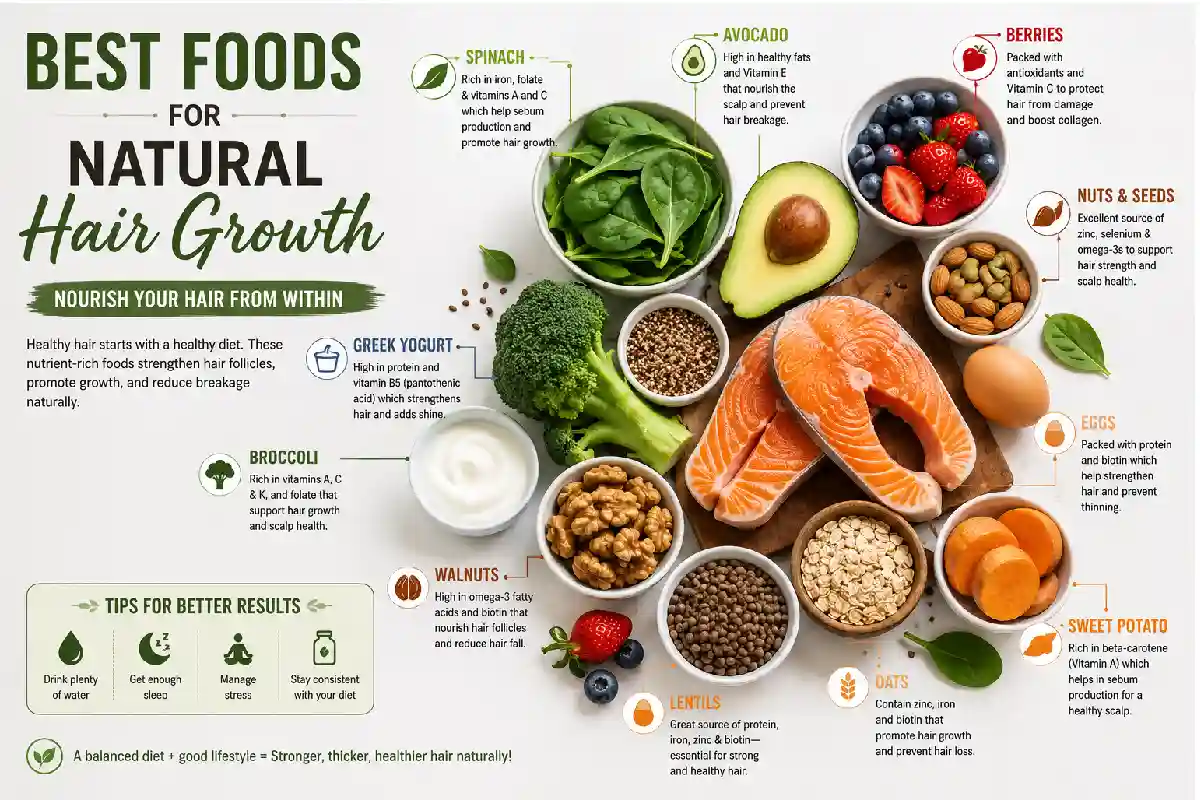
Best Foods for Natural Hair Growth – You Won’t Grow the Best Hair With Shampoo Only. It is what the body consumes on a daily basis to produce good, strong, shiny and healthy hair. Hair thickness, strength and growth remain largely determined by diet, genes and hormones. The body’s most metabolically active cells, hair follicles are incredibly dependent on consistent and complete nourishment – so much so, that even a slight nutritional imbalance can make hair the first thing to suffer, with shedding, brittle breakage and growth stagnation.
In the following article, we will detail exactly what nutrients our hair needs to thrive and which of those nutrients can be sourced naturally to help boost growth from the inside out.
❝
This article is a part of
Natural Hair Care Guide
Why does nutrition matter?
Hair consists mainly of protein known as keratin, and individual hairs grow from the body’s pores in which are fed by microscopic blood vessels to deliver blood cells carrying oxygen and the many nutrients your hair needs.
For a complete overview, explore our guide to natural hair growth and discover the key factors that support healthier hair.
Like non-essential cells that do not threaten the body’s ability to function, hair growth will take the very back seat in your body’s ability to function correctly when and if the nutrients your hair needs are lacking. This is why nutritional deficiencies will often reveal themselves first by the thinning of your hair, the excessive hair loss, slow growth or dull hair before any others.
Eating a healthy balanced diet help in the growth cycle by: supplying proteins which build and help in the creation of keratin, helping to supply oxygen to the hair follicles through blood supply, help in tissue growth and also helps oil gland in follicles to flourish, providing the body with necessary Omega3 acids and finally helping in hair shaft flexibility and preventing breaking by keeping the body’s well hydrated.
Pairing a healthy diet with these natural hair growth remedies can help improve your overall hair care routine.
Below we’re going to go into each and every one of these categories, including a specific range of easy-to-cook meals.
| Nutrient | Role in Hair Health | Deficiency Signs |
| Protein | Builds keratin, the structural protein of hair | Weak, brittle hair; slowed growth |
| Iron | Carries oxygen to hair follicles | Hair thinning, excessive shedding |
| Zinc | Supports follicle repair and oil gland function | Dry scalp, hair loss |
| Omega-3s | Nourishes scalp, reduces inflammation | Dry, dull hair; itchy scalp |
| Water | Maintains hair elasticity and moisture | Dry, brittle strands prone to breakage |
Protein-Rich Foods
When it’s composed of 95% protein (keratin), it makes perfect sense that it would be the top most critical hair nutrient.
Applying the right natural hair growth oils can nourish your scalp while your diet supports hair from within.
When your body isn’t receiving adequate amounts of protein, it switches gears to the emergency phase and the active phase of hair follicles are switched off to the resting stage. This causes telogen effluvium or excess shedding of hair. Protein required for the growth of hair is obtained from both animal and plant-based proteins, although the former contains a richer composition of essential amino acids compared to the latter. A major amino acid in the keratin formation process is the amino acid cysteine, which can be found in high amounts in legumes, poultry and eggs.
Along with nutritious foods, certain hair growth supplements may help fill nutritional gaps that affect hair health.
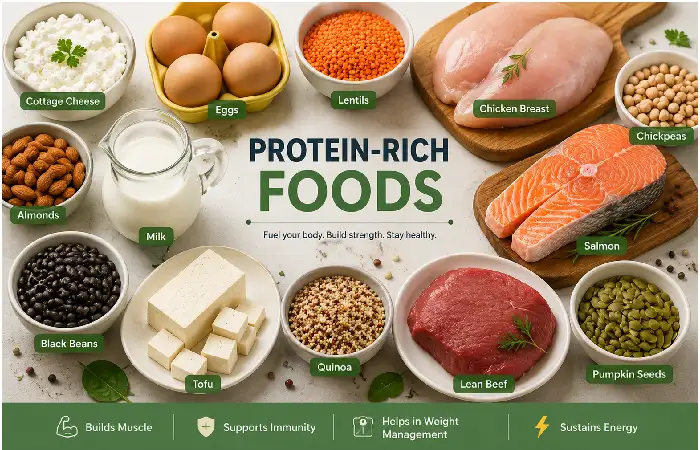
Some of the foods that are high in protein to support your hair growth include:-
- Eggs (and are also packed with biotin, which the building block of keratin)
- Poultry- lean sources include turkey and chicken. Salmon, tuna and other fish.
- Greek yogurt and cottage cheese.
- Beans – chickpeas, black beans, and lentils.
- Tofu and tempeh, nuts including pumpkin and almonds.
| Food | Protein per Serving | Additional Hair Benefits |
| Eggs (2 large) | ~12g | Biotin, vitamin B12, selenium |
| Chicken breast (100g) | ~31g | Iron, zinc |
| Salmon (100g) | ~25g | Omega-3 fatty acids, vitamin D |
| Greek yogurt (1 cup) | ~23g | Calcium, vitamin B12 |
| Lentils (1 cup cooked) | ~18g | Iron, folate |
| Almonds (1 oz) | ~6g | Vitamin E, biotin |
It is better to distribute protein throughout all meals rather than focusing it at dinner. Some sources show that dividing up your protein consumption through all meals allows your body to utilize the protein in a better fashion for the repair of your tissues (hair follicles being one of them).
Iron-Rich Foods
Knowing the hair growth cycle can help you understand how nutrition influences each stage of hair growth.
Iron deficiency: one of the commonest nutritional deficits to cause hair loss ( particularly in women )
Iron supports your body to manufacture haemoglobin, which transports oxygen in the body. If you don’t have sufficient blood cells to support hair growth, then oxygen doesn’t reach your hair follicles. The hair follicles get tired quickly, start resting, and shed early.
There are two kinds of dietary iron: heme and non-heme iron.
Heme iron can be found in animal products and it is more easily absorbed by the body compared to non-heme iron that can be found in foods of plant origin and it is better absorbed when taken together with vitamin C.
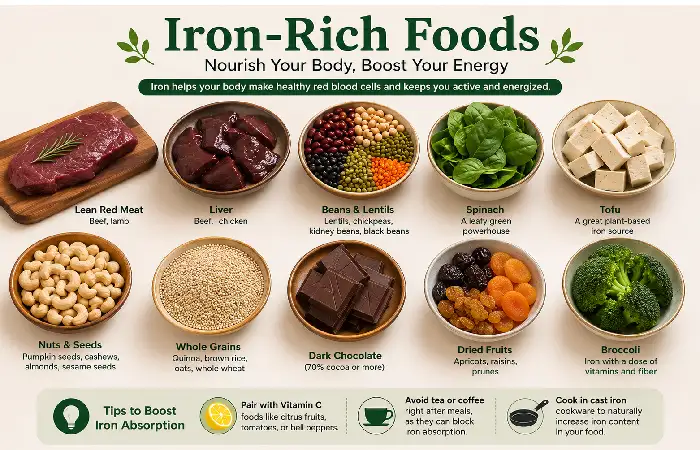
Here is a list of foods high in iron to consume:
- Red meat (beef and lamb)
- Organ meat (liver)
- Shellfish (clams and oysters)
- Dark leafy greens (spinach)
- Pumpkin seeds
- Fortified cereals
- Quinoa
| Food | Iron per Serving | Iron Type |
| Beef (100g) | ~2.6mg | Heme |
| Chicken liver (100g) | ~9mg | Heme |
| Oysters (100g) | ~5mg | Heme |
| Spinach (1 cup cooked) | ~6.4mg | Non-heme |
| Pumpkin seeds (1 oz) | ~2.5mg | Non-heme |
| Lentils (1 cup cooked) | ~6.6mg | Non-heme |
Tips: Take the max you can for your iron. Take all your iron-rich foods with some Vitamin C sources that include: fruits, citrus, oranges, tomatoes, bell peppers And skip coffee or tea, they have compounds that inhibit your iron absorption from meals with tannins.
Zinc and healthy hair
The role of zinc in health: Zinc plays a key role in the development of tissues for hair and its repair, as well as oil gland health. It also has implications in the maintenance of healthy hair, and the lack of it has led to hair loss that can be reversed with the supplement.
DNA and RNA synthesis are also aided by it, as are these processes essential to fast cell growth in the hair follicles. Zinc maintains healthy immunity, which ensures that your scalp and hair is safe from all kinds of disease. Where can you get it from? Top foods include oysters (clearly a leading food in zinc), lamb, beef, chickpeas, beans, pumpkin, sesame, sunflower seeds and any tree nut or whole grain like quinoa.
| Food | Zinc per Serving | Notes |
| Oysters (100g) | ~16mg | Exceptionally high source |
| Beef (100g) | ~4.8mg | Also rich in iron |
| Pumpkin seeds (1 oz) | ~2.2mg | Great plant-based option |
| Chickpeas (1 cup cooked) | ~2.5mg | Also high in protein and fiber |
| Cashews (1 oz) | ~1.6mg | Convenient snack option |
| Cheddar cheese (1 oz) | ~1mg | Pairs well with other meals |
There is also some competition between the two for absorption, and absorption if taken via supplement, so you can generally obtain sufficient zinc and iron from diet instead of supplements (unless prescribed to be supplemented by a doctor because of deficiencies.)
Omega-3 fatty acids
These are important essential fatty acids that can’t be made by your own body and must be obtained from diet.
These oils give nourishment to your scalp, soothe irritation, and have the potential to create a more robust appearance by lengthening the phase during which your hair follicles are capable of growth.
Inflammation of your scalp caused by factors like your environment or diet. You can help build up the fatty layer of your scalp to help prevent flakiness by incorporating these kinds of fats (along with their cousinsomega-6 and 9!) into your diet:
Food Sources High in Omega-3 fatty acids
Fish such as salmon, sardines and mackerel
4 cups cooked oats (containing omega-3 ALA)
Walnuts, salmon, flaxseeds and chia seeds (and their oils), soybean and soybean oil
| Food | Omega-3 per Serving | Type |
| Salmon (100g) | ~2.3g | EPA/DHA |
| Mackerel (100g) | ~2.5g | EPA/DHA |
| Walnuts (1 oz) | ~2.5g | ALA |
| Flaxseeds (1 tbsp) | ~2.3g | ALA |
| Chia seeds (1 tbsp) | ~2.5g | ALA |
| Soybean oil (1 tbsp) | ~0.9g | ALA |
What is Alpha Linolenic Acid?
This is an omega-3 acid that has proved useful in hair loss and damage/breakage, as w,ell as the growth of hair, especially for people who do not consume fish. Only a small fraction of the ALA you consume gets converted to the active form of ALA which is DHA and EPA. Simply sprinkled on oatmeal, smoothies or salad – just 2-3 teaspoons of flaxseed a day – gives your ALA intake the kick it needs.
Hydration and Healthy Hair
You would not think it can be a factor but water is very important for healthy hair, and it’s likely the most important thing for any healthy body function. Your hairs actually consists of a percentage of water and if you get sufficient water intake, then your hair can bounce without breaking. If you don’t, you could be prone to a flaky and itchy scalp that will encourage loss. Even the most amazing nutrients for hair growth don’t stand much chance of reaching your hair follicles through the blood stream without a good water supply.
Hydration tips for healthy hair:
- Sip a minimum of eight glasses (2 litres) of water each day – more if you’re actively engaged or if the climate is warm.
- Focus on foods with high water content. Watermelon, oranges, celery and cucumbers can be an ideal and tasty snack that contributes to adequate water consumption.
- Reduce your alcohol and caffeine consumption, as they tend to act like mild diuretics (you will end up urinating more frequently as a result of drinking them.
- The color of urine can also serve as an indication. If the urine is pale yellow in color it indicates good water consumption.
| Hydration Source | Water Content | Extra Benefit |
| Cucumber | ~96% | Silica for hair strength |
| Watermelon | ~92% | Vitamin A and C |
| Oranges | ~87% | Vitamin C for iron absorption |
| Celery | ~95% | Low calorie, high fiber |
| Plain water | 100% | No additives, ideal baseline |
Final thoughts
There isn’t one magic hair growth food that can boost growth on its own. Instead, the most effective strategy is to eat a diet that is rich in all the important nutrients for healthy hair growth, focusing on: Ensuring each meal contains a source of protein; consuming foods rich in iron and zinc, including omega-3 sources 2-3 times per week; keeping yourself properly hydrated throughout the day
It’s important to know that hair growth is a slow process; it may take a few months for changes in diet to impact on how fast your hair is growing as hair goes through active growth, resting, and falling stages. Don’t aim for perfection just consistency is the key! And if you have a large amount of hair loss and other health issues, please do check in with a doctor as it could be a vitamin or other issue not connected to your food intake. Eating whole foods full of iron, omega-3s, zinc, and protein, plus drinking plenty of fluids can help boost natural hair growth!