

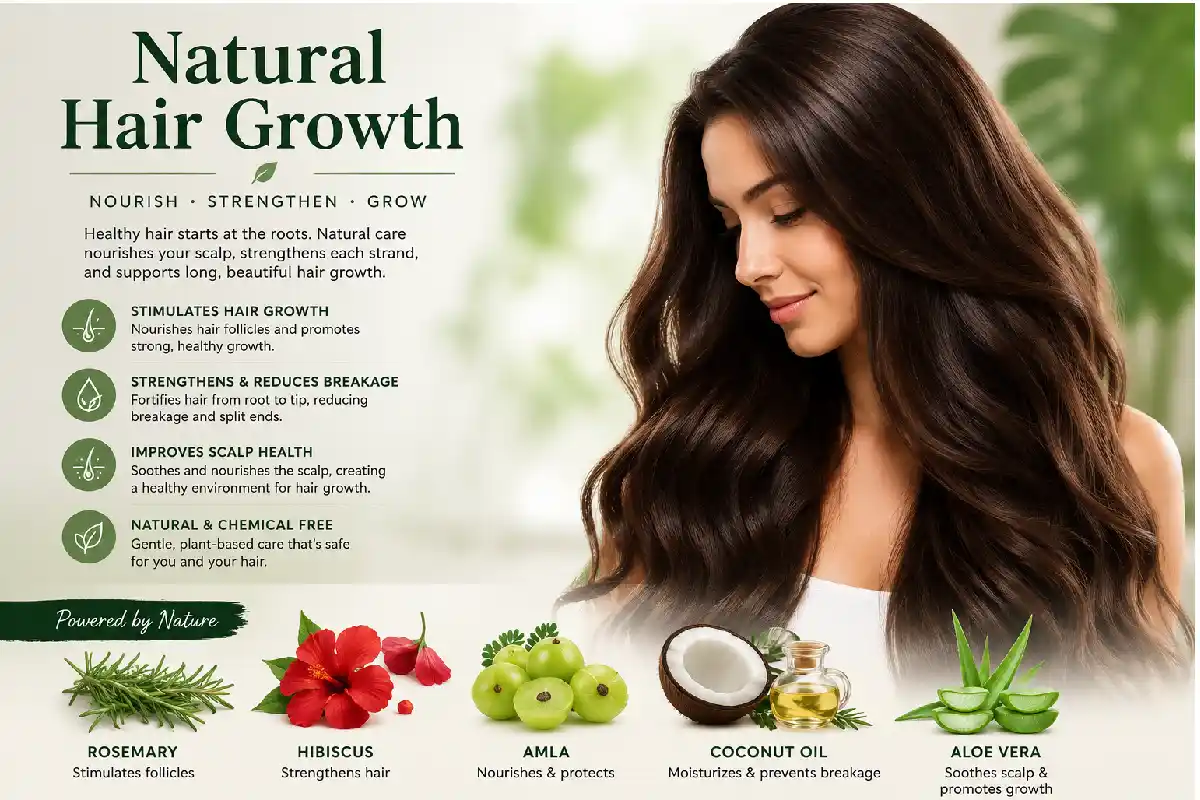
Natural Hair Growth: Complete Guide to Growing Healthier, Stronger Hair Naturally
 Khizrana Begum
Beauty & Lifestyle Writer
Khizrana Begum writes clear and reader-friendly content covering beauty, lifestyle and related topics.
Read Full Bio of Author →
Khizrana Begum
Beauty & Lifestyle Writer
Khizrana Begum writes clear and reader-friendly content covering beauty, lifestyle and related topics.
Read Full Bio of Author →
 Sameena Begum
Health, Technology & Digital Content Reviewer
Sameena Begum reviews content for clarity, accuracy and overall reader usefulness.
Read Full Bio of Reviewer →
Sameena Begum
Health, Technology & Digital Content Reviewer
Sameena Begum reviews content for clarity, accuracy and overall reader usefulness.
Read Full Bio of Reviewer →
Natural Hair Growth: There’s no shortage of hair growth advice online, and most of it promises more than it can deliver. So let’s start with what’s actually true: no oil, supplement, or scalp scrub is going to make your hair grow faster than your genetics allow. What natural methods are doing – where you’ll see the benefit – is preventing breakage hair loss, helping calm your irritated scalp, and repairing that quiet nutrient deficiency that is quietly stunting growth. Less flashy promise, sure, but it’s a sustainable one.
❝
This article is a part of
Natural Hair Care Guide
What Is Natural Hair Growth?
“Natural hair growth” is a buzzword tossed out often, but in essence, it refers to supporting the hair you already have with diet, lifestyle choices, hair and scalp health routines, and botanical remedies – as opposed to utilizing surgical methods such as transplants or medications like Rogaine or minoxidil.
If you’re looking for natural solutions, explore these natural hair growth remedies to support healthier, stronger hair.
Here’s the part most articles skip: growth rate at the follicle is basically fixed by biology. What you’re actually controlling is retention — how much of that growth you keep instead of snapping off at the ends or shedding prematurely. A lot of “my hair grew so much faster” stories are really “I stopped breaking it off just as fast as it grew.”
Using the right natural hair growth oils can nourish your scalp and promote healthier hair growth.
| Natural Approach | Focuses On | Realistic Outcome |
| Diet & nutrition | Feeding follicles from within | Fewer deficiency-related growth issues |
| Scalp care | Circulation, buildup, inflammation | Healthier environment for follicles |
| Reduced heat/chemical damage | Preventing breakage | Better length retention |
| Natural oils & extracts | Moisture, mild stimulation | Softer, shinier, less brittle hair |
| Consistent routine | Long-term habit building | Gradual, cumulative improvement |
Natural Doesn’t Mean Faster
People may get a misconception that, because natural options are ‘softer,’ they will have an impact far more quickly than a more drastic clinical approach; typically, it’s the reverse!
Eating the right foods for natural hair growth provides essential nutrients for stronger, healthier hair.
A drug like minoxidil is directly manipulating follicle activity; rosemary oil and a better diet are working around the edges, fixing root causes. That’s slower by nature, but it also comes without the side effect list.
Understanding the Hair Growth Cycle
If your hair issues come from a poor diet, constant heat styling, tight braids, or just never touching your scalp, natural methods will probably make a real difference. However, you’re going to need a dermatologist, not just to spend six months on the hair-growth magic of rosemary oil, to sort out if you have genetic hair loss, an autoimmune disease, or significant hormonal imbalance.
Want better results? Learn how to grow hair faster naturally with simple lifestyle and hair care changes.
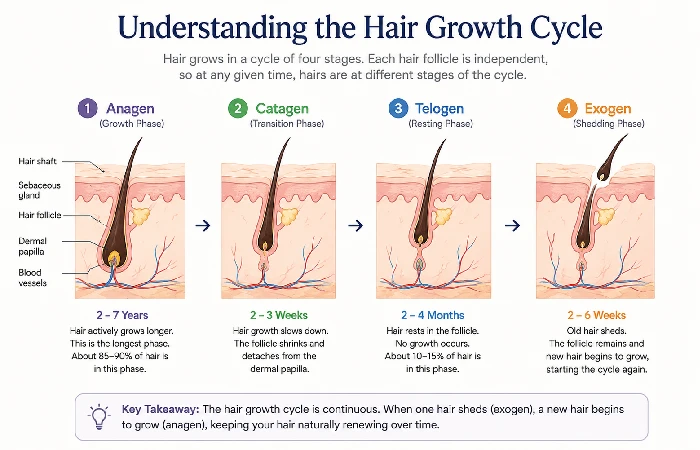
Each strand cycles through phases, and understanding this explains a lot — like why hair loss products take months to “work,” and why losing hair every single day is completely normal.
Four Stages of Hair Growth
| Phase | Name | What Happens | Typical Duration |
| 1 | Anagen (Growth) | Active cell division in the follicle; hair grows continuously | 2–7 years |
| 2 | Catagen (Transition) | Growth stops; the follicle shrinks and detaches from blood supply | 2–3 weeks |
| 3 | Telogen (Resting) | Hair remains in the follicle but doesn’t grow | 2–3 months |
| 4 | Exogen (Shedding) | Old hair sheds; new hair begins pushing through | Ongoing, overlaps with anagen |
At any given moment, about 85–90% of the hair on your head is actively growing. The rest is somewhere between resting and falling out. Losing 50 to 100 strands a day isn’t a sign anything’s wrong — it’s just the cycle doing its job.
Choosing the right hair growth supplements may help support healthy hair from the inside out.
The Anatomy Behind Each Strand
So for a bit of a handy anatomy lesson – the follicle is a hole in your scalp through which your hair grows out; the bottom of the hole contains the bulb, where the cells actually replicate; the hair fibre growing up out of the hole is called the shaft, and is encased in a layer of cuticle scales. Hot tools or chemical treatments can’t reach the follicle and make the hair inside the bulb cease its growth, but they can seriously destroy those scales on the shaft. And that’s what leads to breakage and splits that convince you your hair’s not growimg.
Not Every Hair Is on the Same Clock
Your follicles aren’t synchronized. At any point, some are growing, some are resting, some are shedding — which is why hair loss and regrowth happen gradually instead of all at once. The length of your anagen (growth) phase, which is mostly genetic, is really what caps how long your hair can get. Some people’s hair “maxes out” at shoulder length no matter what they do; others can grow hair down to their waist. That’s biology, not a failure of your routine.
Understanding the hair growth cycle can help you set realistic expectations for hair growth and shedding.
Factors That Affect Hair Growth
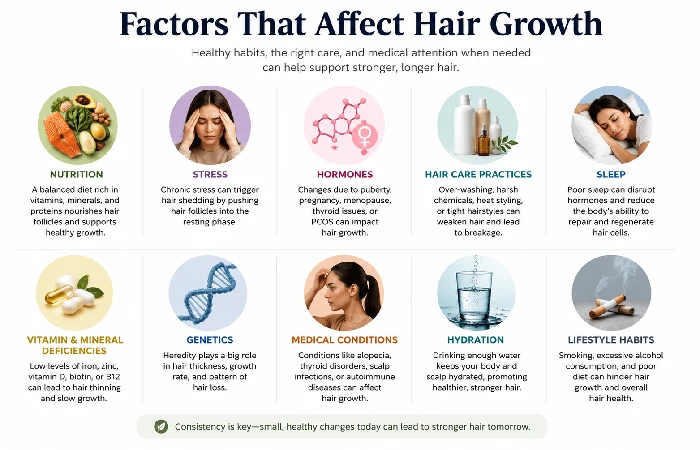
Some things about your hair you can change. Some you’re stuck with. Knowing the difference saves you money and frustration.
Factors You Cannot Control
Genetics – Determines your base rate of growth, hair thickness, and how long your anagen stage goes. Age – Your rate of growth begins to decline, follicle count falls with age, and your anagen phase begins to shorten. Hormones – thyroid hormones, estrogen, testosterone andDHT are all hormones involved. A change in your levels – due to pregnancy, menopause, or a condition like thyroid disease – may increase your hair loss rate or alter your texture.
Ethnicity — growth rates and strand structure differ somewhat across hair types and backgrounds.
Factors You Can Influence
| Factor | Impact on Hair | How to Improve It |
| Nutrition | Fuels keratin production and follicle metabolism | Adequate protein, iron, zinc, biotin |
| Scalp health | Determines follicle environment | Regular cleansing, exfoliation, massage |
| Stress levels | Chronic stress triggers shedding | Sleep, exercise, stress management |
| Heat & chemical exposure | Causes breakage, split ends | Limit heat styling, harsh dyes/relaxers |
| Hydration | Affects hair elasticity and scalp condition | Adequate water intake, moisturizing products |
| Sleep quality | Affects hormone regulation and cell repair | 7–9 hours of consistent sleep |
| Physical manipulation | Tight styles cause traction and breakage | Loose protective styles, gentle detangling |
Hormones Deserve Their Own Paragraph
This one trips people up. Androgens like testosterone and its byproduct DHT can shrink follicles over time in people who are genetically wired to be sensitive to them — that’s the actual mechanism behind pattern baldness, in both men and women. Thyroid problems, whether it’s an underactive or overactive thyroid, mess with the growth cycle too, usually causing all-over thinning rather than a receding hairline or bald patch.
And if you’ve had a baby, started or stopped birth control, or gone through perimenopause and noticed your hair suddenly shedding more — that’s real, and it’s hormonal. Postpartum shedding especially catches people off guard: pregnancy hormones keep more hair in the growth phase than usual, so when hormone levels drop after delivery, a few months later there’s a wave of shedding as all that hair exits at once. It’s alarming but almost always temporary, resolving within 6 to 12 months.
The Environment Plays a Role Too
A few less obvious contributors:
It dehydrates and damages the cuticle – just like it can your skin – from too much sun exposure. On top of anything you’re already applying, pollutants accumulate on the surface of your skin and hair over the course of a day or a week. This can also cause mineral build-up in the strands that can leave hair stiff and brittle. The toxins in cigarette smoke have a way of impairing blood supply to the hair roots and that causes damage to your locks.
Certain medications — some blood thinners, antidepressants, blood pressure drugs — list thinning as a side effect worth asking your doctor about if it lines up with when the shedding started.
Daily Habits That Support Natural Hair Growth
None of these are exciting. That’s kind of the point — consistency beats novelty here.
Wash Gently, Not Constantly
Clean regularly to eliminate excess and grease but avoid over-washing so your scalp isn’t dried out. For many, two to three days are perfect, although your scalp’s oil levels make a big difference.
Don’t Use the Heat
Water feels nice, but it leaves your cuticles ragged and robs hair of its natural oils, leading to frizz and damage. Aim for the moderately cool side while shampooing and use cool water to rinse and seal everything off at the conclusion.
Scrub Your Scalp
You may get results in only a couple of minutes daily, whenever you feel like doing so. Some studies suggest it stimulates blood flow into the hair follicles and although research is limited, there’s no cost and it feels nice.
Shield Hair at night
Less friction between the fabric and your hair is the result of silk or satin pillowcases, compared to ones of cotton.
Hair breaks less and appears less frizzy in the morning. A loose braid is also useful before you go to bed.
Go Easy on the Heat
Flat irons and blow dryers on high heat, day after day, are one of the fastest ways to wreck your ends. If you’re using heat, use a protectant and turn the temperature down — you probably don’t need it as hot as you think.
Actually Get Your Trims
Every 8 to 12 weeks, trim off split ends before they travel up the shaft and turn one small problem into a bigger one.
Detangle from the bottom up
Because it’s most delicate when it’s wet, work from the bottom up when detangling. Use a wide-tooth comb
Go easy on the protective styles
Loose braids, buns, and twists cut down on daily manipulation. But pulled-too-tight styles cause traction alopecia — permanent hair loss at the hairline from constant pulling. Tight isn’t the same as protective.
Drink Water
Weight wise hair is water, this can feel the hair dry, brittle when dehydrated for too long.
Manage stress before it manages your hair
Chronic stress pushes follicles into their resting phase early. Sleep, exercise, and just generally not running yourself into the ground all help — indirectly, but really.
Don’t Forget Sun Protection
Long stretches in direct sun weaken the cuticle just like it does your skin. A hat, or a leave-in with UV filters, helps — especially if your hair is color-treated or already damaged.
| Habit | Frequency | Primary Benefit |
| Gentle cleansing | 2–3x per week | Removes buildup without over-stripping |
| Scalp massage | Daily, 3–5 minutes | Improves circulation |
| Silk/satin pillowcase | Every night | Reduces friction and breakage |
| Heat protectant use | Every heat styling session | Reduces cuticle damage |
| Trims | Every 8–12 weeks | Prevents split ends from traveling |
| Gentle detangling | Every wash day | Minimizes breakage |
| Protective styling | As needed, not too tight | Reduces daily manipulation |
Best Natural Ingredients for Hair Growth
A lot of “natural” hair ingredients have decent tradition behind them and a thinner layer of actual science. That doesn’t make them useless — it just means treat them as supportive, not miraculous.
| Ingredient | Common Use | Reported Benefits |
| Rosemary oil | Scalp treatment, diluted in carrier oil | May improve circulation; some studies compare it favorably to minoxidil for shedding |
| Castor oil | Scalp and strand treatment | Rich in ricinoleic acid; moisturizes and may reduce breakage |
| Coconut oil | Pre-wash treatment, leave-in | Penetrates hair shaft, reduces protein loss |
| Peppermint oil | Diluted scalp massage | May stimulate circulation and give a cooling, refreshing sensation |
| Aloe vera | Scalp gel, leave-in treatment | Soothes irritation, moisturizes, has mild anti-inflammatory properties |
| Onion juice | Scalp treatment (diluted) | Some studies link sulfur content to improved regrowth in alopecia areata |
| Green tea extract | Rinse or product ingredient | Antioxidant properties may protect follicles from oxidative stress |
| Argan oil | Leave-in, styling product | Rich in vitamin E and fatty acids; adds shine, cuts frizz |
| Fenugreek seeds | Soaked, blended into paste | Contains protein and nicotinic acid; used traditionally for hair strength |
| Biotin-rich oils | Various carrier oil blends | Helps if biotin is actually low, otherwise minimal effect |
Using Oils Without Making a Mess of Things
- Dilute essential oils like rosemary or peppermint in a carrier oil (jojoba, coconut, olive) before it touches your scalp — undiluted, they can irritate.
- Patch test anything new on your inner arm 24-48 hours before it goes near your scalp. Yes, even “natural” stuff can cause a reaction.
- Leave treatments on anywhere from 30 minutes to overnight depending on the ingredient, then wash out normally.
- Don’t leave raw onion juice on longer than instructed — sensitive scalps really don’t love prolonged exposure to it, however trendy it is.
Honestly, most of the research supporting the above ingredients was done in a handful of tiny trials, and a thing that worked in one study didn’t work in another. Treat them more like ingredients (that may or may not!) improve the health and appearance of your hair, rather than as an actual hair loss treatment. The foods and vitamins that can actually improve the texture and look of hair The biggest part of your hair is a protein known as keratin.
Your body needs those building blocks to make the protein throughout.
The part of the body that will notice deficiency most prominently is your hair. This is often one of the simplest things you can fix about a receding hairline or any other form of hair loss.
Nutrition and Vitamins for Healthy Hair
| Nutrient | Role in Hair Health | Food Sources |
| Protein | Building block of keratin | Eggs, fish, chicken, legumes, tofu |
| Iron | Carries oxygen to hair follicles | Red meat, spinach, lentils, fortified cereals |
| Zinc | Supports tissue growth and repair | Oysters, pumpkin seeds, chickpeas, beef |
| Biotin (B7) | Supports keratin infrastructure | Eggs, almonds, sweet potatoes, salmon |
| Vitamin D | Linked to follicle cycling | Sunlight, fatty fish, fortified dairy |
| Vitamin A | Supports sebum production | Carrots, sweet potatoes, spinach |
| Vitamin C | Aids collagen production, iron absorption | Citrus fruits, bell peppers, strawberries |
| Vitamin E | Antioxidant, supports scalp circulation | Almonds, sunflower seeds, avocado |
| Omega-3 fatty acids | Supports scalp hydration, reduces inflammation | Salmon, walnuts, flaxseeds, chia seeds |
| Selenium | Supports follicle health | Brazil nuts, tuna, whole grains |
What Your Hair Is Trying to Tell You
- Thinning that’s spread evenly across your whole scalp, rather than in patches, usually points to iron deficiency, thyroid issues, or just not eating enough overall.
- Hair that snaps easily, even when it’s not that long, often means you’re not getting enough protein — this shows up a lot in people on aggressive diets.
- Dry, dull hair paired with a flaky scalp can mean low intake of fatty acids or vitamin A.
Do You Actually Need Supplements?
Only if you’re deficient!
If you have perfectly fine levels of biotin and start taking a biotin supplement daily, you’re not going to suddenly grow longer, faster hair.
But, if you overdo a supplement like vitamin A too often, it may actually harm your hair, over time! Before you start on ANY supplements, do a blood test, and talk to your doctor about it, particularly if you take any other medications!
Scalp Care for Faster Hair Growth
Treat your scalp like the soil of your plant. If you neglect the soil, the plants will always be scraggly, no matter how great the seeds are.
Elements to Include in Your Basic Hair Growth Routine:
| Step | Purpose | Suggested Frequency |
| Cleansing | Removes oil, product buildup, and dead skin | 2–3x per week |
| Exfoliation | Clears clogged follicles, removes flakes | 1x per week |
| Massage | Improves circulation, relieves tension | Daily |
| Moisturizing | Prevents dryness and flaking | As needed, based on scalp type |
| Treatments (oils, serums) | Targeted support for specific concerns | 1–3x per week |
Signs Your Scalp Isn’t Happy
- Itchy or flaky, and it doesn’t go away between washes
- Greasy again within a day of washing
- Redness or tenderness you can actually feel when you touch it
- Irritation from a hairstyle that doesn’t heal on its own
Exfoliating Your Scalp (Yes, Really)
Same idea as exfoliating your face — dead skin and product residue build up and can clog follicles over time. You’ve got a few options:
- A physical scalp scrub with gentle exfoliating grains
- A chemical exfoliant, like a diluted salicylic acid formulated for scalp use
- A soft-bristled scalp brush used while shampooing
Once a week is plenty. More than that and you risk irritating a scalp you were trying to help.
Dealing With Dandruff and Buildup
Most dandruff comes down to a yeast called Malassezia — it lives on every scalp, but it overgrows under the right (wrong) conditions. Anti-dandruff shampoos with zinc pyrithione, ketoconazole, or salicylic acid genuinely help here, used consistently, alongside just washing regularly enough that buildup doesn’t get a chance to accumulate.
A Simple Weekly Scalp Schedule
You don’t need a complicated routine — something like this covers the bases:
| Day | Scalp Care Activity |
| Monday | Scalp massage (dry, 5 minutes) |
| Tuesday | Rest day |
| Wednesday | Cleanse + scalp massage during shampooing |
| Thursday | Rest day |
| Friday | Oil treatment (applied a few hours or overnight before washing) |
| Saturday | Cleanse, exfoliate, rinse out oil treatment |
| Sunday | Rest day |
Rest days aren’t laziness — over-manipulating the scalp causes its own problems.
When to Stop DIY-ing and See a Dermatologist?
Get it checked out if you notice:
- Patchy hair loss with a smooth, shiny scalp underneath
- Redness or scaling that won’t budge with over-the-counter stuff
- Hair loss that happens fast, over just a few weeks
- Sores, crusting, or anything that looks infected
These can point to things like alopecia areata, scalp psoriasis, or a fungal infection — none of which oils and shampoo swaps are going to fix on their own.
Hair Care Mistakes That Slow Growth?
You can do everything right and still undo it with one bad habit you didn’t think mattered.
| Mistake | Why It’s Harmful | Better Alternative |
| Over-washing | Strips natural oils, dries scalp and strands | Wash 2–3x per week based on hair type |
| Excessive heat styling | Weakens the hair shaft, causes breakage | Air dry when possible, use heat protectant |
| Tight hairstyles | Causes traction alopecia at the hairline | Choose looser styles, rotate part lines |
| Brushing wet hair roughly | Hair is most fragile when wet | Use a wide-tooth comb, detangle gently |
| Skipping trims | Split ends travel up the shaft | Trim every 8–12 weeks |
| Chemical overload (relaxers, bleach) | Weakens protein structure over time | Space out chemical treatments, use bonding treatments |
| Ignoring scalp health | Clogged, inflamed follicles grow poorly | Regular cleansing and exfoliation |
| Crash dieting | Deprives follicles of protein and micronutrients | Maintain balanced, adequate caloric intake |
| Sleeping on rough cotton pillowcases | Increases friction and breakage overnight | Switch to silk or satin |
| Using too much product | Causes buildup that suffocates follicles | Use products sparingly, cleanse regularly |
| High stress without management | Can trigger telogen effluvium | Prioritize sleep, exercise, relaxation techniques |
It’s the Small Stuff That Adds Up
None of these mistakes will wreck your hair after one bad day. It’s daily high heat, tight styles, and skipped trims stacked on top of each other for a year that quietly cost you inches — even while your hair is technically growing just fine underneath.
If the list above feels overwhelming, don’t try to fix everything at once:
- This week: switch to a silk pillowcase, stop brushing rough when hair’s wet.
- Next month: cut heat styling down, always use a protectant when you do use it.
- Ongoing: actually book that trim every couple months and put it on your calendar so it doesn’t slip.
- Longer term: check that your protective styles aren’t tugging at your hairline, and space chemical treatments at least 8 weeks apart.
Small changes made one at a time also make it easier to tell what’s actually helping.
How Long Does Natural Hair Growth Take?
Hair grows about half an inch a month on average — roughly six inches a year — though this swings depending on genetics, age, and overall health.
Average Hair Growth Timeline
| Time Frame | Expected Growth | Notes |
| 1 month | ~0.5 inch (1.25 cm) | Growth rate is fairly consistent short-term |
| 3 months | ~1.5 inches (3.75 cm) | Early improvements from better care may become noticeable |
| 6 months | ~3 inches (7.5 cm) | Enough time to judge if a new routine is working |
| 1 year | ~6 inches (15 cm) | Full hair growth cycle changes become more visible |
Why You Have to Wait It Out?
Because of the cycle we covered earlier, a follicle currently resting won’t respond to a new shampoo or supplement immediately — it has to finish resting and re-enter the growth phase first. That’s why most experts say give a new routine at least three to six months before deciding whether it’s working. Quitting after two weeks tells you nothing.
Don’t Fall for the Marketing
Be skeptical of anything promising dramatic length in a few weeks — it’s just not how hair biology works for most people. What real progress from a natural routine actually looks like:
- Less hair coming out when you brush or wash
- Fewer split ends, less snapping
- Hair that seems to “grow faster” mostly because you’re losing less of it
- Better shine, softer texture, a scalp that isn’t constantly itchy
Frequently Asked Questions
Does trimming hair make it grow faster?
No — trimming doesn’t touch the root or the growth rate. What it does is remove split ends before they travel up the strand and cause more breakage, so you keep more of the length you’re growing.
Can scalp massage really stimulate hair growth?
There’s some decent small-scale evidence that regular massage improves blood flow to follicles and can even slightly increase hair thickness over months. The research isn’t huge, but it costs nothing to try.
Is rosemary oil as effective as minoxidil?
A handful of small studies found it comparable to low-dose minoxidil for reducing shedding. The studies are small, so take it as “promising,” not “proven,” but it’s worth trying if you’d rather go the natural route first.
How often should I wash my hair for optimal growth?
Two to three times a week works for most people — enough to keep the scalp clean without stripping the oils it actually needs.
Can stress really cause hair loss?
Yes. Serious physical or emotional stress can shove a bunch of follicles into their resting phase at once, and you’ll typically notice the shedding two to three months later. It usually resolves once the stress does.
Do supplements like biotin actually help hair grow?
Only if you were actually deficient to begin with. If your biotin levels are normal, extra biotin isn’t likely to do much, though it’s low-risk at typical doses.
Is it normal to lose hair every day?
Completely normal — 50 to 100 strands a day is just the cycle running its course. A sudden spike in shedding or visible thinning is what’s actually worth mentioning to a doctor.
How long should I try a natural hair care routine before giving up?
At least three to six months. Hair grows in cycles, and results at the root level just don’t show up faster than that.
Can diet alone regrow hair that’s been lost?
It can help if the original cause was a nutrient deficiency. It generally won’t reverse loss caused by genetics or a medical condition — that’s a conversation for a dermatologist, not a grocery list.
Are natural remedies safe for all hair types?
Mostly, yes, but sensitivities vary person to person. Patch test anything new, and keep in mind curly, coily, or chemically treated hair often needs different dilution ratios or application methods than straight hair.
Does hair grow faster in summer than winter?
Some research suggests slightly faster growth in warmer months, possibly tied to increased scalp circulation — but the difference is small enough that most people wouldn’t notice it in daily life.
Can wearing hats or helmets slow hair growth?
No, not on their own. Hats don’t suffocate follicles. Just make sure they’re not so tight they’re pulling at your hairline, and keep the scalp underneath clean.
Is it better to air dry or blow dry hair?
Air drying is gentler since there’s no direct heat involved. But blow drying on low heat with a protectant is a fine alternative when you’re short on time — it can even cut down how long hair spends wet and vulnerable.