


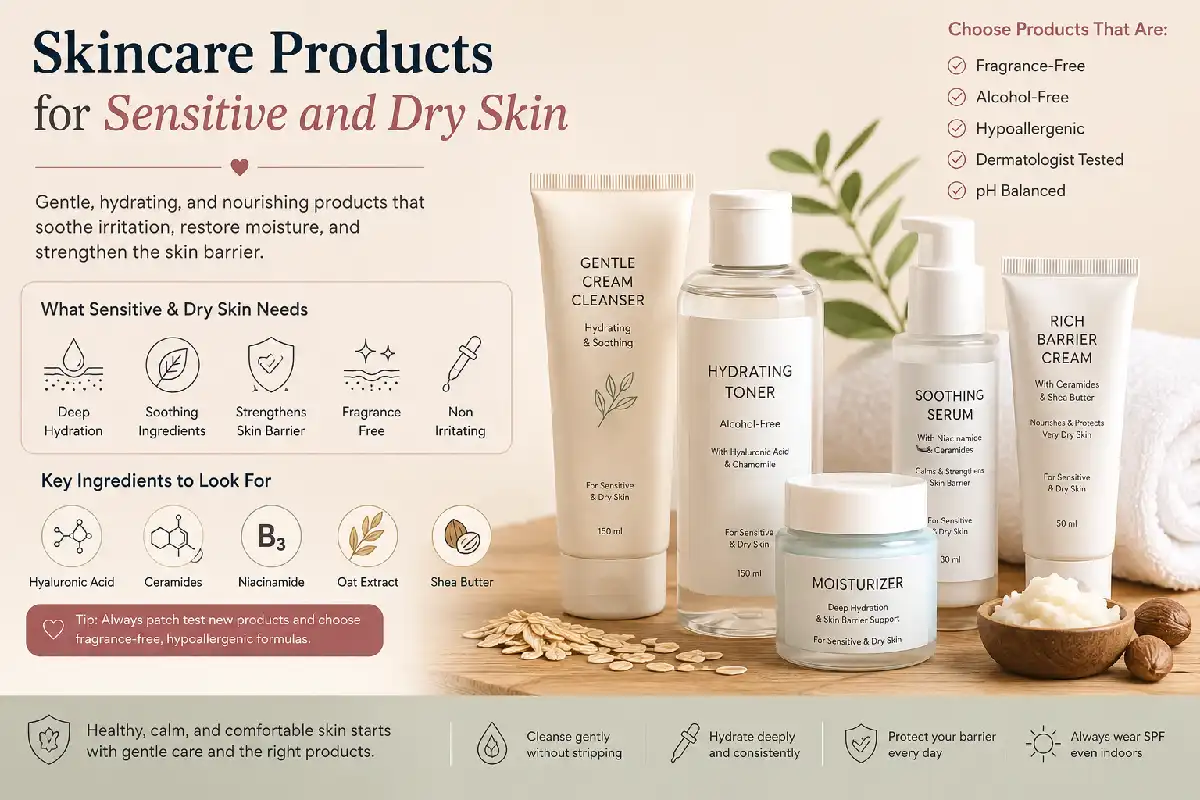
Skincare Products for Sensitive and Dry Skin: Right Products for Lasting Hydration
Last Updated: July 30, 2026
Skincare Products for Sensitive and Dry Skin – Managing sensitive, dry skin is often a challenge; you want to find a solution but can never seem to work out the best moisturizing and soothing regimen. When your skin becomes dry, tight and tight you then begin dealing with flaking.
The great news is that it’s possible to not only heal and repair the skin barrier, but also lock in moisture and desensitize the skin over time with the correct approach to skin care.
Here’s what you need to know when it comes to dry and sensitive skin – including why they are often so interlinked, how to cleanse and moisturize correctly and the best ingredients for these skin types, as well as tips on how to manage your skin during winter and much more!
Why is dry skin more sensitive?
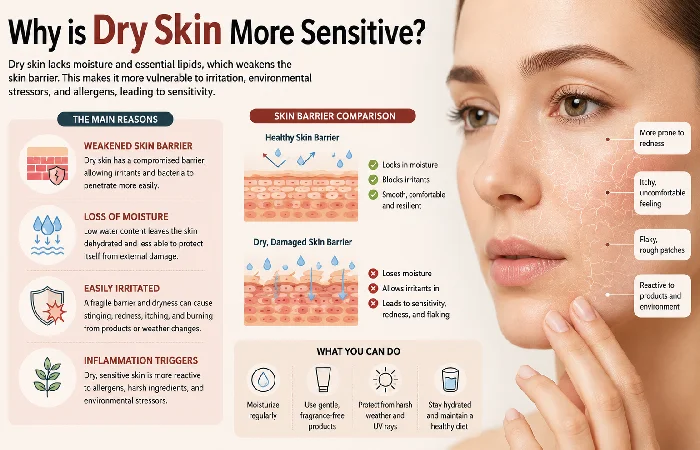
Your skin isn’t healthy if there’s insufficient water and oil within your topmost skin layers. An important job your skin has to perform is this: The more your skin barrier is weakened, the more the outside surfaces can be susceptible to allergens and irritants.
Skin barrier: what is it?
Your skin barrier, also known as the stratum corneum, is your skin’s protective outer layer. Its functions include:
- Help prevent skin from losing moisture
- Provide a protective layer to prevent foreign matter and bacteria from entering the skin
- Help prevent damage from the elements
- Help maintain the correct moisture balance in the skin
Common Signs of Sensitive and Dry Skin
| Symptom | Dry Skin | Sensitive Skin |
| Tightness | ✓ | ✓ |
| Flaking | ✓ | Sometimes |
| Redness | Sometimes | ✓ |
| Burning Sensation | Rare | ✓ |
| Itching | ✓ | ✓ |
| Reaction to Products | Sometimes | ✓ |
| Rough Texture | ✓ | Sometimes |
Causes of Sensitive Dry Skin
Several factors can contribute to both dryness and sensitivity:
| Cause | Impact on Skin |
| Cold Weather | Reduces moisture levels |
| Hot Showers | Strips natural oils |
| Harsh Cleansers | Damages skin barrier |
| Aging | Decreases natural oil production |
| UV Exposure | Weakens protective barrier |
| Allergens | Triggers inflammation |
| Over-Exfoliation | Causes irritation and dryness |
| Genetics | Influences skin type and sensitivity |
When you feel both sensitivity and dryness simultaneously, a regimen that prioritizes gentle products to balance and soothe both of you is all that you really require.
Cleansing Tips
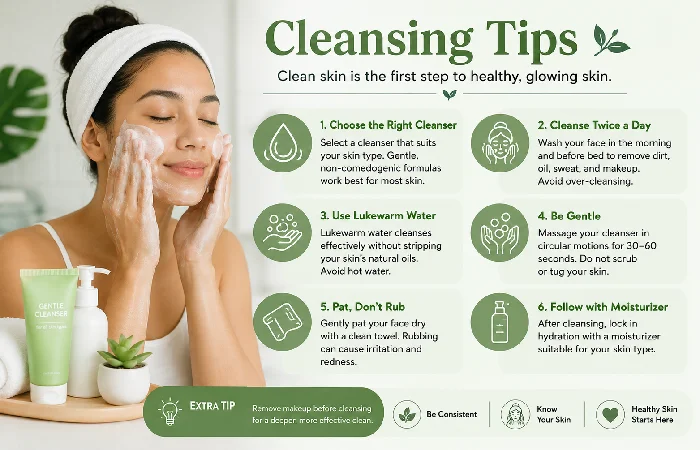
When you need it both simultaneously You do not require an aggressive cleanser because of being sensitive and extremely dry, therefore, you have to pay attention to this component of care. Cleansers For some, Cleansers may look small part of any skin care strategy
. But picking the wrong cleanser can make sensitivity and dryness exponentially worse! What to look for in your Cleanser A good sensitive and dry skin cleanser should do the
- Remove dirt without stripping oils
- Maintain skin’s natural pH
- Support the skin barrier
- Avoid harsh ingredients
Ingredients to Avoid in Cleansers
| Ingredient | Why Avoid It |
| Sulfates (SLS, SLES) | Can strip moisture |
| Alcohol Denat | Causes dryness |
| Artificial Fragrance | May trigger irritation |
| Harsh Scrubs | Damage skin barrier |
| Strong Acids | Can increase sensitivity |
Best Types of Cleansers
| Cleanser Type | Benefits |
| Cream Cleanser | Hydrating and gentle |
| Milk Cleanser | Softens skin |
| Oil Cleanser | Removes makeup without drying |
| Hydrating Gel Cleanser | Refreshes while maintaining moisture |
| Balm Cleanser | Nourishing and soothing |
Best practices cleansing routine and method
Morning
- Use water that ranges from cold to warm
- Use facial cleanser
- Rinse well.
- Pat your skin dry.
Evening
- Remove sunscreen/makeup.
- Using a gentle soap.
- Don’t wash it hard; rinse-wash face. Wash a lot.
- Then apply the face lotion immediately
Common mistakes during face wash:
- Washing 2 times or more per day.
- Using hot water.
- Overexfoliating.
- Using cleansing brushes vigorously.
- Choosing products with a strong scent
Many sensitive skins do better with a simple than complicated cleansing routine.
Moisturizing Routine
For dry and sensitive skin, this is actually the MOST essential of all steps; it restores hydration to the skin, reinforces the skin barrier and thus alleviates inflammation.
Benefits.
Minimize water loss.
- Softer texture
- Less redness
- Improved barrier function
- Better protection against environmental damage
Components of an Effective Moisturizer
A quality moisturizer typically contains:
| Component | Function |
| Humectants | Attract water |
| Emollients | Smooth skin |
| Occlusives | Seal in moisture |
Daily Moisturizing Routine
Morning Routine
| Step | Product Type |
| Cleanse | Gentle hydrating cleanser |
| Hydrate | Optional hydrating serum |
| Moisturize | Barrier-repair cream |
| Protect | SPF 30+ sunscreen |
Evening Routine
| Step | Product Type |
| Cleanse | Cream or oil cleanser |
| Treatment | Gentle soothing serum |
| Moisturize | Rich cream |
| Seal | Optional occlusive balm |
Layering Products Correctly
Apply products from thinnest to thickest:
- Toner (optional)
- Serum
- Moisturizer
- Facial oil
- Occlusive balm
Signs Your Moisturizer Is Working
- Less flaking
- Reduced redness
- Softer skin
- Less itching
- Improved elasticity
Signs You Need a Different Moisturizer
| Sign | Possible Issue |
| Continued Tightness | Not hydrating enough |
| Burning Sensation | Irritating ingredient |
| Increased Redness | Product sensitivity |
| Breakouts | Formula too heavy |
Consistency is more important than using multiple products.
Best Ingredients
The right ingredients for dry and sensitive skin can actually work miracles Hyaluronic Acid For its ability to bind the most water to itself, this effective humectant is in every dry and sensitive skin must-have, because as it pulls hydration into the skin, it fills and plumps from within.
Benefits
- Increases hydration
- Improves plumpness
- Reduces roughness
- Helps protect skin’s elasticity
Glycerin
Glycerin is one of the most powerful moisturizing agents.
Benefits
| Benefit | Description |
| Hydration | Draws moisture into skin |
| Barrier Support | Strengthens protection |
| Softness | Smooths rough patches |
| Compatibility | Suitable for most skin types |
Ceramides
Ceramides naturally occur in the skin barrier.
Benefits
- Restore barrier function
- Reduce moisture loss
- Improve resilience
- Minimize irritation
Niacinamide
Niacinamide is a gentler form of B3.
Benefits
| Benefit | Result |
| Barrier Repair | Stronger skin |
| Reduced Redness | Calmer complexion |
| Improved Hydration | Better moisture retention |
| Oil Regulation | Balanced skin |
Colloidal Oatmeal
Often recommended for sensitive skin.
Benefits
- Soothes irritation
- Reduces itching
- Protects barrier
- Calms inflammation
Panthenol (Vitamin B5)
Panthenol helps maintain hydration and repair skin.
Benefits
- Moisturizing
- Soothing
- Healing support
- Reduced irritation
Squalane
Squalane is a lightweight emollient.
Benefits
| Benefit | Description |
| Lightweight | Doesn’t feel greasy |
| Moisturizing | Softens skin |
| Protective | Supports barrier |
| Non-Irritating | Suitable for sensitivity |
Aloe Vera
Aloe vera is known for its soothing properties.
Benefits
- Reduces redness
- Hydrates skin
- Calms irritation
- Supports healing
Shea Butter
A rich moisturizer that protects dry skin.
Benefits
- Deep nourishment
- Reduced flaking
- Improved softness
- Long-lasting hydration
Ingredients That Work Well Together
| Combination | Benefits |
| Ceramides + Hyaluronic Acid | Hydration and barrier repair |
| Glycerin + Panthenol | Moisture and soothing |
| Niacinamide + Ceramides | Strengthening and calming |
| Aloe Vera + Oatmeal | Relief from irritation |
| Squalane + Shea Butter | Lasting moisture |
Ingredients Sensitive Skin Should Approach Carefully
| Ingredient | Reason |
| High Alcohol Content | Drying |
| Strong Fragrance | Irritating |
| Essential Oils | Potential allergens |
| Strong Retinoids | May cause irritation |
| High-Concentration Acids | Can weaken barrier |
Not everyone reacts the same way, but patch testing is always recommended.
Winter Skincare – Top Tips
For dry, sensitive skin the winter can be very challenging. Cold temperatures, with dry, still air are coupled by the artificially warm and dry indoor environments along with the biting wind, all of which contribute to the severe loss of moisture.
Winter and the aggravation of dry skin
During winter:
- Humidity drops
- Water evaporates faster
- Skin produces less oil
- Heating systems reduce indoor moisture
Winter Skin Challenges
| Problem | Cause |
| Cracking | Severe dryness |
| Redness | Cold exposure |
| Itching | Moisture loss |
| Flaking | Barrier damage |
| Tightness | Dehydration |
Adjust Your Cleanser
Switch to a more hydrating cleanser during winter.
Look for:
- Cream cleansers
- Oil-based cleansers
- Sulfate-free formulas
Use a Richer Moisturizer
Winter often requires thicker moisturizers.
Features to look for:
- Ceramides
- Shea butter
- Squalane
- Fatty acids
Apply Moisturizer Immediately
Dermatologists often recommend moisturizing within a few minutes of washing.
This helps:
- Trap moisture
- Reduce water loss
- Build a Barrier Skin barrier is very important
It is better to not skipping any UV ray It is easy to stop using cream with SPF during the cold season, but UV still exists.
Use humidifier
Use humidifier during the winter month, Indoor heater dries up the indoor air, so apply humidifier to maintain moisture balance indoor, which can reduce risk from the air.
A humidifier helps:
| Benefit | Result |
| Adds Moisture | Less dryness |
| Supports Barrier | Reduced irritation |
| Improves Comfort | Softer skin |
Avoid Long Hot Showers
Hot water removes protective oils.
Instead:
- Use lukewarm water
- Limit shower time
- Moisturize afterward
Protect Skin Outdoors
Wear:
- Scarves
- Gloves
- Hats
These help shield skin from cold winds and harsh temperatures.
Winter Skincare Routine Example
| Step | Morning | Evening |
| Cleanser | Hydrating cleanser | Cream cleanser |
| Serum | Hyaluronic acid | Panthenol serum |
| Moisturizer | Barrier cream | Rich moisturizer |
| Sunscreen | SPF 30+ | Not needed |
| Occlusive Balm | Optional | Recommended |
Building the Ideal Sensitive Skin Routine
Minimal Morning Routine
- Gentle cleanser
- Hydrating serum
- Moisturizer
- Sunscreen
Minimal Evening Routine
- Gentle cleanser
- Soothing serum
- Rich moisturizer
Weekly Care
| Treatment | Frequency |
| Hydrating Mask | 1–2 times weekly |
| Gentle Exfoliation | Once weekly |
| Barrier Repair Treatment | As needed |
A minimalist routine often produces the best results for sensitive skin.
Common Mistakes to Avoid
Using Too Many Products
More products increase the risk of irritation.
Frequently Changing Products
Skin needs time to adapt.
Ignoring Patch Tests
Always test new products on a small area first.
Over-Exfoliating
Doing too much exfoliating can p@ss up the barrier and cause high sensitivi@y.
Skipping Moisturizer
Natural or oily, even combination skin needs to have moisture injected into it.
FAQs
Product picks for sensitive, dry skin
Look for products containing Ceramides, Hyaluronic Acid, Glycerin, Panthenol, Colloidal Oatmeal & Squalane.
All these are beneficial for delivering hydration and reinforcing the skin barrier.
How often do you need to moisturize dry skin?
It is the most common habit to cleanse skin twice daily but it is also recommended for most to moisturize twice a day.
Can sensitive skin use exfoliants?
Yes, but gentle exfoliants should be used infrequently; ideally once a week, no more in order not to irritate skin.
Is fragrance bad for sensitive skin?
Potential skin irritant and trigger of allergic reactions. Fragrance-free product is more desirable.
Should I use toner if I have dry skin?
Only if it is alcohol free and hydrated. Most people with dry skin can do without toner.
Are natural products always better for sensitive skin?
False. Natural ingredients are still capable of triggering an allergy. Make sure you patch-test new products.
What ingredients repair the skin barrier?
Ingredients that provide the best barrier support are!
Why does my skin feel tight after I wash my face?
Maybe your cleanser is too stripping – your skin has probably lost some of its natural oil. For this you should try a creamier and more moisturizing cleanser.
What is the time frame to repair a damaged skin barrier?
A mild barrier injury may recover within a few weeks of damage, but a more severe scarring can take several months with persistent recovery.
Can sunscreen help sensitive skin?
Yes. Uv protection is important anyway, so yes, applying a daily sunscreen is an effective way of preventing flare-ups.
Conclusion
It is difficult to choose the right products for sensitve and dry skin, however your skin barrier must be protected so look for calming and nourishing products. Try using a gentle cleanser, a barrier repair moisturizer, and a day-use broad spectrum sunscreen. All those changes are going to help do great things when it comes to protecting and repairing sensitive dry skin until irritation resolves fully, but let’s just go back to the roots.
Use simple but trusty-and effective and soothing-ingredients such as ceramides, glycerin, hyaluronic acid, colloidal oatmeal, panthenol, and squalane. Trade in those harsh, stripping cleansers, quit being so abrasive on your face (read: Don’t go crazy on the exfoliation!), and, oh yeah-bye bye those irritating fragrances.
With diligence, this set of practices and products will promote more comfortable and a more resilient sensitive dry skin.