


Mindfulness for Mental Health: A Practical Guide to Finding Calm in a Busy World
Last Updated: July 2, 2026
Mindfulness for Mental Health: The most crucial element for holistic wellness today is Mental health. The modern lifestyle of this era, coupled with the current day’s world is so demanding. As a result of this hectic schedule, most of the times we deal with mental stress, emotional fatigue, anxiety and constant distractions.
And while there are myriad of ways in which one can ensure good mental well-being, mindfulness for mental health is undoubtedly the most efficient one!
What Is Mindfulness?
Mindfulness is not about clearing the head or creating mental quiet, but it is about being aware and observant in the current moment with an open, curious, and accepting attitude. By cultivating Mindfulness, one can get to cope with stress better, improve one’s emotional equilibrium and enhance relationship with his/herself.
The following segments that we will include are: the benefits and definition of mindfulness, the easiest mindfulness for beginners, how to practice mindfulness breathing, mindful living and not to do.
All Mindfulness Is is awareness of whatever you’re doing and whatever you’re feeling, and of nothing in particular else. Not guilty about the past, and don’t be anxious about the future, but simply awareness of what is here.
At its core, mindfulness involves:
- Awareness of thoughts and emotions
- Paying attention to physical sensations
- Observing experiences without criticism
Embracing the present, as is. Many think of mindfulness in long-duration meditation but it’s a way to embrace normal day to day activities too.
These include going about your routine – while eating, working, taking a walk, even chatting with friends.
Traditional Thinking vs Mindful Thinking
| Traditional Thinking | Mindful Thinking |
| Focuses on past mistakes | Focuses on the present moment |
| Reacts automatically | Responds thoughtfully |
| Judges experiences | Observes experiences |
| Creates mental stress | Promotes emotional balance |
| Encourages overthinking | Encourages awareness |
Mindfulness is basically a mental practice which is able to enhance concentration and also emotional management.
Benefits of Mindfulness
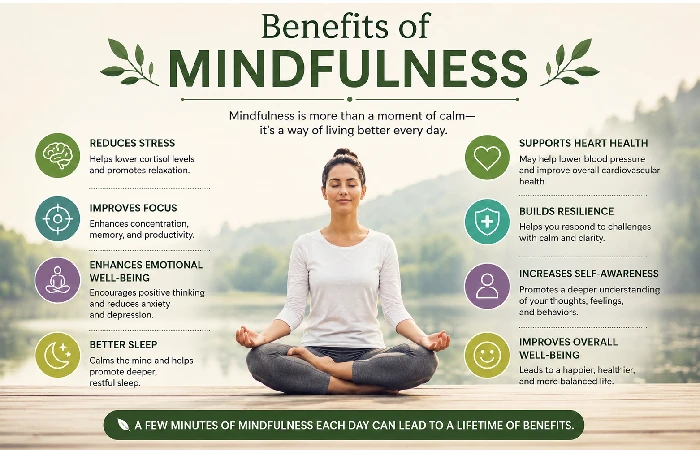
Research has shown that mindfulness can improve mental and physical health and can be an extremely helpful way to cope with challenging circumstances by increasing people’s ability to be more self aware
Stress Reduction Mindf
1. Reduces Stress
ulness helps people to recognize their thoughts and learn not to get attached to them, this naturally reduces stress.
Mindfulness helps:
- Lower mental tension
- Improve emotional control
- Reduce feelings of overwhelm
- Increase relaxation
2. Improves Emotional Health
Mindfulness people can accept how they feel without judging it or denying its reality.
Benefits include:
- Better mood stability
- Reduced irritability
- Increased self-awareness
- Greater emotional resilience
3. Supports Anxiety Management
When it comes to causes of anxiety, worries about things to come are a biggie. The ability of mindfulness to ground ourselves in the present can therefore be a helpful intervention in an ever cycling loop of self doubt.
4. Enhances Focus and Concentration
Tech demands for everyone of us these days pulls our brain in million places.
Mindfulness meditation gives us practice at returning our attention to what is right here and now.
5. Improves Sleep Quality
Try meditation: The thought racing in your head will start to calm down.
6. Strengthens Relationships
Authentic communication and real-time listening are the seeds of successful healthy relationships for each of us.
Key Mental Health Benefits
| Benefit | Impact on Daily Life |
| Reduced Stress | Improved calmness |
| Better Focus | Higher productivity |
| Emotional Regulation | Fewer mood swings |
| Better Sleep | Increased energy |
| Reduced Anxiety | More confidence |
| Self-Awareness | Better decision-making |
Mindfulness Exercises for Beginners
When folks take part in speaking as well as mindful listening, associations feel as though a garden.
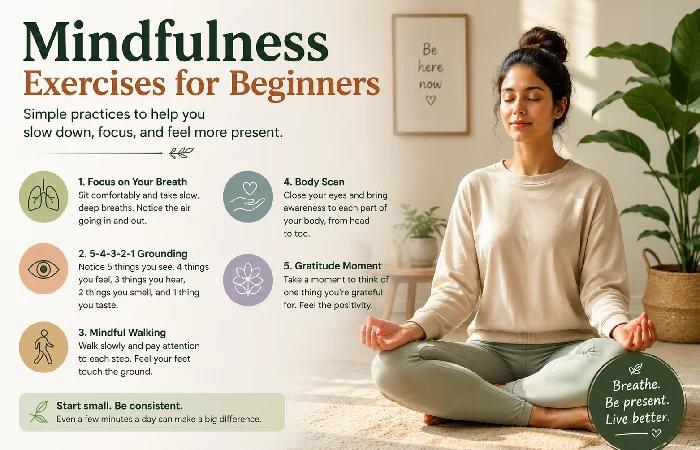
1. Five-Senses Exercise
Focus your attention on your physical body in this current moment.
Notice:
- 5 things you can see
- 4 things you can touch
- 3 things you can hear
- 2 things you can smell
- 1 thing you can taste
The activity is useful at stressful times.
2. Body Scan Meditation
When you do a body scan, you focus your awareness on various parts of your body, moving down your head to toes.
Steps:
- Get yourself comfortable.
- Close your eyes.
- Bring your attention to your breath.
- Begin to bring attention to each of your body parts gradually.
- Observe the tension without forcing it to change.
This practice helps improve mind-body awareness.
3. Mindful Observation
Pick one everyday object, like a flower, pen, or even a leaf, cup or even one of your toes if you have one that’s willing to perform.
Spend one minute observing:
- Color
- Texture
- Shape
- Details
This can teach your brain to concentrate instead of going into a zone.
4. Mindful Listening
Pay attention to sounds without identifying them.
Focus on:
- Bird sounds
- Traffic noises
- Air conditioning
- Background conversations
The goal is awareness, not analysis.
5. Gratitude Reflection
Write down three things you’re grateful for every single night.
The regularity will gradually instil a positive mindset.
Breathing Techniques
Mindfulness breathing exercises: The easiest and strongest tools
Since we’re always breathing it makes for a perfect anchor point
1. Deep Belly Breathing
Also known as diaphragmatic breathing.
Steps:
- Sit comfortably.
- Put one hand on chest.
- Put one hand on abdomen.
- Breathe in through nose, slowly.
- Allow stomach to expand out.
- Breathe out through mouth, slowly.
Benefits:
- Lowers stress levels
- Slows heart rate
- Encourages relaxation
2. Box Breathing
Popular among athletes and professionals for improving focus.
Pattern:
| Step | Duration |
| Inhale | 4 seconds |
| Hold | 4 seconds |
| Exhale | 4 seconds |
| Hold | 4 seconds |
Repeat for several cycles.
Benefits
- Improves concentration
- Reduces anxiety
- Creates mental clarity
3. 4-7-8 Breathing
A calming breathing technique.
Pattern
| Action | Duration |
| Inhale | 4 seconds |
| Hold | 7 seconds |
| Exhale | 8 seconds |
This method is especially helpful before sleep.
4. Counting Breath Meditation
Simply count each breath:
- Inhale = 1
- Exhale = 2
- Continue to 10
- Start over
As your thoughts wander, quietly bring them back to counting.
Use it to enhance concentration and mindfulness.
Mindful Living Practices
Being a mindful isn’t solely confined to meditation. Mindfulness can be cultivated and practiced in ordinary moments, just by incorporating tiny mindful acts.
Mindful Eating
Eat elsewhere, not at your desk. Not over your computer, not in front of the television.
- Notice flavors
- Pay attention to textures
- Eat slowly
- Appreciate each bite
Mindful eating often improves digestion and satisfaction.
Mindful Walking
Walking can become a form of meditation.
Focus on:
- Footsteps
- Body movement
- Breathing rhythm
- Surrounding sounds
A 10 minute mind walk could be great.
Mindful Technology Use
Digital distractions take their toll: Digital distractions, if unchecked, increase stress levels and decrease the brain’s ability to concentrate.
Try:
- Turning off unnecessary notifications
- Taking screen-free breaks
- Using devices intentionally
- Creating technology-free periods
Mindful Communication
During conversations:
- Listen fully before responding
- Avoid interrupting
- Maintain eye contact
- Notice emotional reactions
Strengthen both personal and professional relationships with Mindful Communication.
Mindful Morning Routine
Start with intention to kickstart the day.
A simple routine might include:
| Activity | Time |
| Deep Breathing | 3 minutes |
| Gratitude Reflection | 2 minutes |
| Stretching | 5 minutes |
| Mindful Tea or Coffee | 5 minutes |
| Daily Intention Setting | 2 minutes |
Total time: approximately 15 minutes.
Common Mindfulness Mistakes
Many beginner’s get very put off with the idea of how the brain is meant to be working with mindfulness.
1. Trying to Stop All Thoughts
Mindfulness is not to make yourself thoughtless.
Instead:
- Notice thoughts
- Acknowledge them
- Return attention to the present
Thoughts naturally come and go.
2. Expecting Immediate Results
Mindfulness is something that is practiced to be learned.
Some advantages can be experienced after few weeks of consistent practice.
3. Judging Yourself
People frequently think:
- “I’m not good at meditation.”
- “My mind keeps wandering.”
This is completely normal – returning to awareness is all part of the process
4. Practicing Only During Stress
The practice has the biggest positive effect when practiced habitually rather than only when you feel you are going through the difficulties.
5. Setting Unrealistic Goals
Sitting for an hour as a beginner, you will be more challenged.
A better approach:
| Beginner Stage | Recommended Duration |
| Week 1 | 5 minutes daily |
| Week 2 | 7–10 minutes daily |
| Week 3 | 10–15 minutes daily |
| Week 4+ | 15–20 minutes daily |
Small consistent changes result in remarkable achievements.
Daily Mindfulness Plan for Better Mental Health
This daily mindfulness practice is useful for anyone that is interested in starting a beginner mindfulness practice.
| Time of Day | Mindfulness Activity |
| Morning | Deep breathing and gratitude |
| During Work | One-minute breathing break |
| Lunch | Mindful eating |
| Afternoon | Short mindful walk |
| Evening | Reflection and relaxation |
| Before Bed | 4-7-8 Breath Exercise |
When the process is simple to remember you will find that it easier to stick with the practice.
Conclusion
When it comes to our mental and physical health, mindfulness exercises aren’t just a trend of the clean living craze. In reality they are tools for managing life – including stress, anxiety, all of its ups and downs, and the stresses of life, by learning how to become more intentional in the way we go about our daily lives. Being aware will make us less likely to be thrown off course by an emotional roller coaster ride, it’s proven to sharpen focus, improve relationships, and generally get the mind on a better and more even footing.
The really fantastic news, however, is that this technique does not call for any equipment or expertise or even very much time at all.
Just a few minutes a day of concentrating on observing anything is sufficient to make profound changes.