

Sustainable Fashion Trends: The Future of Eco-Friendly Style
 Khizrana Begum
Beauty & Lifestyle Writer
Khizrana Begum writes clear and reader-friendly content covering beauty, lifestyle and related topics.
Read Full Bio of Author →
Khizrana Begum
Beauty & Lifestyle Writer
Khizrana Begum writes clear and reader-friendly content covering beauty, lifestyle and related topics.
Read Full Bio of Author →
 Sameena Begum
Health, Technology & Digital Content Reviewer
Sameena Begum reviews content for clarity, accuracy and overall reader usefulness.
Read Full Bio of Reviewer →
Sameena Begum
Health, Technology & Digital Content Reviewer
Sameena Begum reviews content for clarity, accuracy and overall reader usefulness.
Read Full Bio of Reviewer →
Sustainable Fashion Trends: What was once a niche idea is now defining how clothing is created, bought, and used. Consumers are buying clothing built to last, that takes minimal resources to produce, and are more conscious of working conditions. Alongside this, designers and companies are integrating recycled materials into their processes, implementing circular approaches to manufacturing, resale services for clothing, and low-impact methods for production.
Sustainability in fashion is not about the conscious purchase of an “eco-friendly” T-shirt; rather, it redefines our relation to clothing, the planet, resources, and the fashion industry as a whole.
❝
This article is a part of
Fashion Trends Guide
What Is Sustainable Fashion?
Sustainable fashion includes clothing, shoes, and accessories produced or manufactured with more care for their impact on the environment, as well as on workers’ human rights. For example, the product could have been made out of recycled or natural and renewable resources; the quantity of energy and water necessary for its production could have been minimized; waste generation and pollution should also be greatly reduced; transparency in the supply chain should be more adequate; and working conditions need to be improved.
Sustainable fashion focuses on making thoughtful choices about clothing, materials, production, and consumption. Explore our complete fashion trends guide for broader style inspiration.
The sustainability of fashion also relates to what will happen with clothing once bought. Clothes need to last; if the products can be repaired, reused, or resold, they’ll have a greater lifetime. The same is also asked of a product designed with the intention of being recycled or disposed of.
| Sustainable principle | What it means |
| Durability | Making products designed to last |
| Resource efficiency | Using less water, energy, and raw materials |
| Responsible materials | Choosing recycled, organic, or lower-impact fibers |
| Ethical production | Supporting fair and safe working conditions |
| Circularity | Keeping clothing in use for longer |
| Waste reduction | Preventing unnecessary textile waste |
Latest Sustainable Fashion Trends
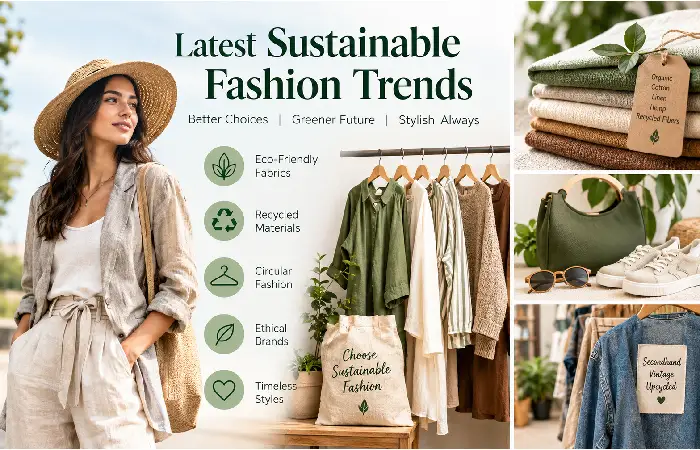
This evolution isn’t driven by any single trend – there are several that are influencing its direction. One of the biggest and most impactful of these trends is Circular Fashion, a system committed to keeping garments and their materials alive rather than following a typical ‘buy-use-discard’ lifestyle. The trend of resale and secondhand Shopping continues to become more commonplace.
Buying secondhand makes fashion more sustainable.
Vintage shops, in addition, have been providing a distinct niche for those searching for one-off items and for prolonging the lives of wearable clothing. From the aforementioned, we also see another rise in several trends that incorporate recycled fibers, clothing repair and care systems, rental, upcycling, made-to-order fashion, and transparency. Furthermore, fashion digital technologies also play a part in helping promote Sustainability. Fashion companies can use digital tracking devices to track inventory and forecasting to avoid excess production and provide customers with digital documentation that outlines a gar
Eco-Friendly Clothing Trends
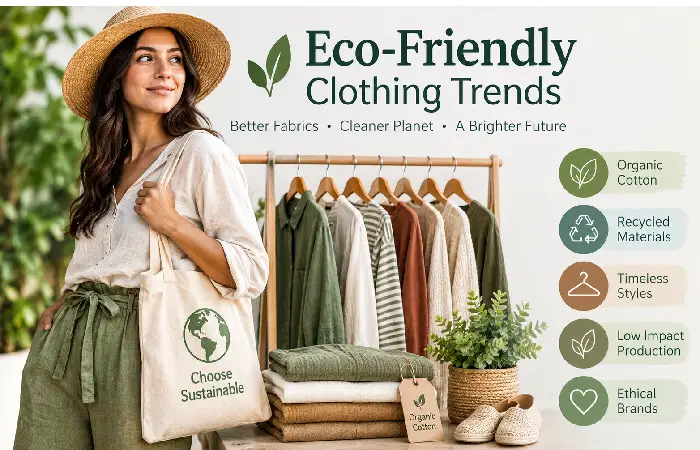
Keeping up with current fashion can help you discover new styles while also considering more mindful wardrobe choices. Explore our latest fashion trends guide for fresh style ideas.
Quality and sustainability are becoming central to the concept of environmentally friendly fashion; discarded seasonal trends are becoming obsolete. Minimalism is making an impact since owning fewer garments and creating a varied wardrobe can avoid unnecessary purchases. Staples of “neutral colors, timeless designs, multi-purpose items, high-quality items” have the tendency to stay “on trend for multiple seasons.”
Finally, ‘Upcycling’ is currently among the most vital trends in this field, which suggests transforming unnecessary garments into completely new ones (while a damaged T-shirt can be transformed into a bag or abandoned fabric used in new clothing).
Finally, there’s the aspect of repair: visible darning, alterations, patchwork, and colorful sewing can add unique style to older garments.
Sustainable Fabrics
A material plays a big part in sustainable fashion. There is not one fabric that is just sustainable, as it may only be sustainable if it is created properly, long-lasting, produced well, transported carefully, and also disposed of responsibly. Examples of low-impact or recycled fabrics that are frequently spoken about are organic cotton, recycled polyester, recycled nylon, hemp, linen and also certain regenerated and new fibers.
| Fabric | Common sustainability advantage |
| Organic cotton | Produced under organic agricultural standards |
| Hemp | Durable fiber that can require relatively few agricultural inputs |
| Linen | Made from flax and known for durability |
| Recycled polyester | Uses existing polyester materials rather than entirely new polyester |
| Recycled nylon | Can divert existing nylon waste into new products |
| Lyocell | Regenerated cellulose fiber produced using a solvent-based process |
| Recycled wool | Reuses existing wool fibers |
Consumers still have to search further into the composition than just the fabric name. There are things like labels, such as certifications, that indicate the processes in which it’s produced.
Slow Fashion Trends
Slow fashion provides an alternative to rapid consumption. It encourages consumers to make more considered purchasing choices rather than to have a spend-crazy attitude, buying fast and cheap clothing that doesn’t last.
Seasonal fashion trends can offer practical inspiration for updating your wardrobe throughout the year. Explore our seasonal fashion trends guide for useful outfit ideas.
Important slow-fashion strategies involve purchasing less clothing, investing in multi-purpose items, mending clothes and treating textiles properly, and patronizing products built to last.
The conscious consumer mindset can also inspire consumers to say: Is this something I really need? Will I wear it frequently? Is it something I can mix-and-match with clothes I already own? Is it quality material, craftsmanship, and construction?
These few questions could save you hundreds of dollars and a cluttered closet.
Secondhand and Vintage Fashion
One of the easiest, and most attainable, types of consumption for the sustainably-inclined shopper is secondhand shopping. Purchasing used clothing, of course, directly contributes to the circularity of clothing, keeping currently existing garments in use and diminishing the need for new ones.
Choosing clothing thoughtfully is an important part of creating a more sustainable and versatile wardrobe. Explore our fashion clothing trends guide for practical inspiration.
Vintage fashion allows sustainability to be mingled with unique individuality. This form of second-hand consumption often reflects characteristics, cuts, fabrics, prints, and methods of construction from times past, all with elements uncommon in mass-market production today.
| Secondhand approach | Benefit |
| Thrift shopping | Gives existing clothing another life |
| Online resale | Makes pre-owned fashion easier to access |
| Vintage shopping | Offers distinctive and historically inspired pieces |
| Clothing swaps | Extends garment use within communities |
| Consignment | Allows unwanted clothing to reach new owners |
Ultimately, though, thrifting serves its best purpose not in promoting excessive pre-owned purchases but in substituting a need for unnecessary new ones.
Ethical Fashion Brands
Ethical fashion’s main focus, above all, is people. The topics it centers around are healthy work environments, proper working conditions, fair wages and treatment, and accountable and responsible suppliers, sourcing, and a transparent supply chain.
When comparing an ethical fashion brand, consumers can identify where clothes are produced, where raw materials come from, and what demands the suppliers and manufacturers meet from a readily accessible page.
Generalities can be tricky, like what some consider being “green”, “conscious” and “eco”. Specific material descriptions, accreditations, and documentation about manufacturers are better than ambiguous statements on a company’s stand.
Colors and personal style can make a meaningful difference when creating outfits that reflect your preferences and lifestyle. Explore our fashion color and style guide for helpful ideas.
Sustainable Accessories
It not only affects clothes but also bags, shoes, jewelry, belts, scarves, and other accessories.
Long-lasting accessories might be more precious, as quality bags, shoes, and artificial leather bags and so on may be used for a long time due to their durability, thus being supplemented by a trend of recycled substances, ethically produced natural materials, reused pieces, and repairable attributes. People may increase the sustainability of their accessories, for instance, by investing in versatile ones that go well with a host of clothes instead of those solely made for fleeting fads.
Building a Sustainable Wardrobe
Sustainable wardrobe-making and building is not about discarding everything that is present in your closet. Actually, using every piece of clothing more efficiently is the actual concept of sustainable fashion in the beginning.
The first practice you can begin with: look at what you own- what do you wear the most frequently? Repair everything that’s in your closet. Pack off the dress or share what doesn’t fit you with others, or sell it to shops. Discover what you actually need.:
- Versatile everyday basics.
- Durable outerwear.
- Comfortable, well-made footwear.
- A few pieces suitable for formal occasions.
- Timeless accessories.
- Clothing that can be layered across seasons.
Focus on the fit of clothing or shoes while shopping rather than fashion; also consider quality, multiple uses of an item, and the anticipated amount of wear.
How Sustainable Fashion Is Changing the Industry
The effect on the industry is occurring on many different levels; brands are looking at and testing many different initiatives ranging from the usage of different raw materials, renewable fibers, repair, resale, rental schemes, and a more transparent supply chain.
Furthermore, we can speak about an industry move toward circularity: rather than thinking of a fashion product as having a limited lifecycle, a circular approach strives to maintain the value, fibers, and the product itself for as long as possible.
| Traditional fashion model | More sustainable model |
| Produce → buy → discard | Produce → use → repair → reuse |
| Trend-driven consumption | Longer-lasting styles |
| Heavy reliance on virgin materials | Greater use of recycled and alternative materials |
| Limited product-life planning | Design for durability and circularity |
| Disposal-focused | Resale, reuse, repair, and recycling |
Wedding and party outfits can be stylish while still allowing you to make more thoughtful choices about what you wear and buy. Explore our wedding and party fashion trends guide for occasion-ready inspiration.
In the end, it’s not about an absolute green fashion wardrobe but conscious decisions that are made at each stage in clothing’s lifetime: from the sources used to make it and the conditions that a garment was produced in; to the purchasing, caring, and repair of a garment; and to clothing, even being resold or given away before finally going to disposal.
As consumers become more in tune with environmental and social aspects, sustainability will still remain a key principle and driving force within fashion. Rather than focusing solely on individual materials and trends, genuine impact will be created by a move to buying less, buying better, keeping items for longer, and achieving a more circular fashion system.