

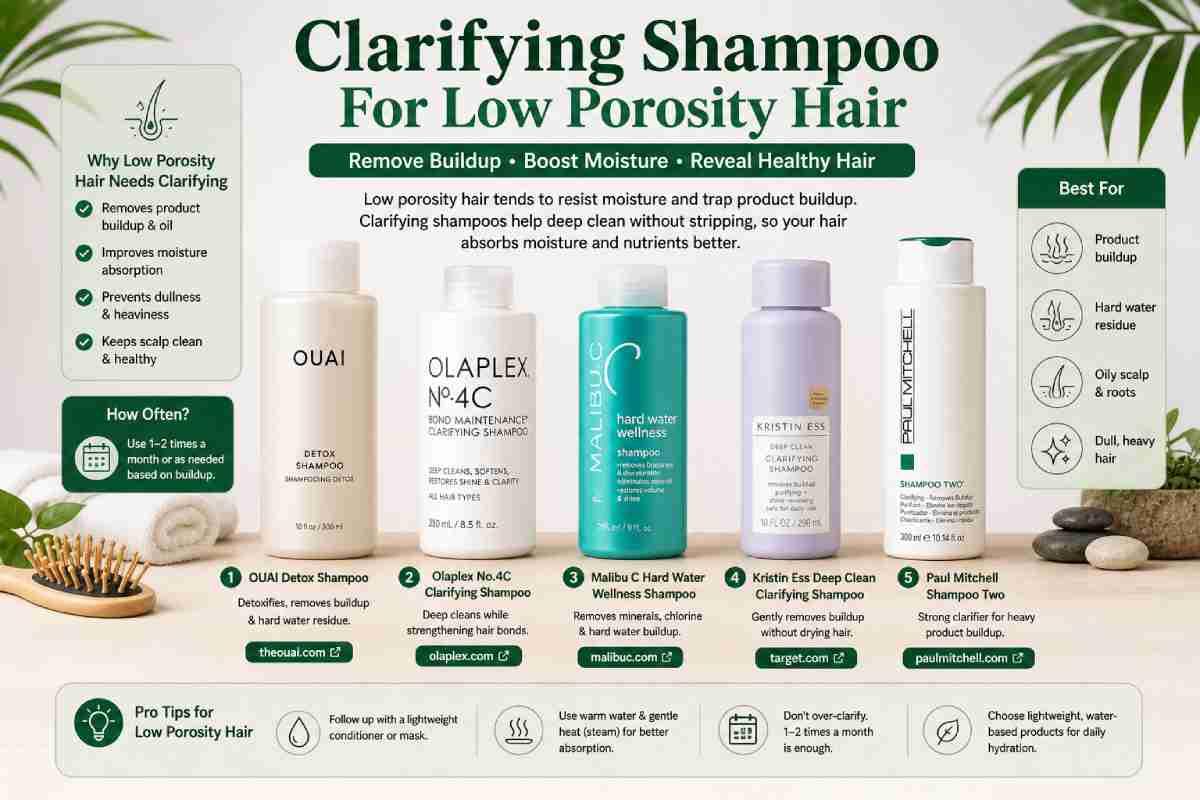
Clarifying Shampoo For Low Porosity Hair – Benefits, Uses & Hair Care Guide
Last Updated: August 3, 2026
Though having a low porosity hair type can lead to some absolutely gorgeous and healthy, shiny hair. The one and only annoying problem you’re going to have to deal with will be product buildup. The cuticle of low porosity hair remains shut so your water, conditioner, oils, gels, and creams do not fully absorb and it will begin to feel coated, dull, or heavy, or strangely dry after a whole wash day.
That is exactly where a clarifying shampoo becomes useful.
A beneficial clarifying shampoo for low porosity hair will assist in removing any buildup your standard shampoo might leave behind, giving your hair a truly clean slate for the moisturizing to actually take place. This is all about the right balance as clarifying is necessary to prevent build up, but too much will dry the hair, leaving it rough, when it’s low porosity.
What Is Low Porosity Hair?
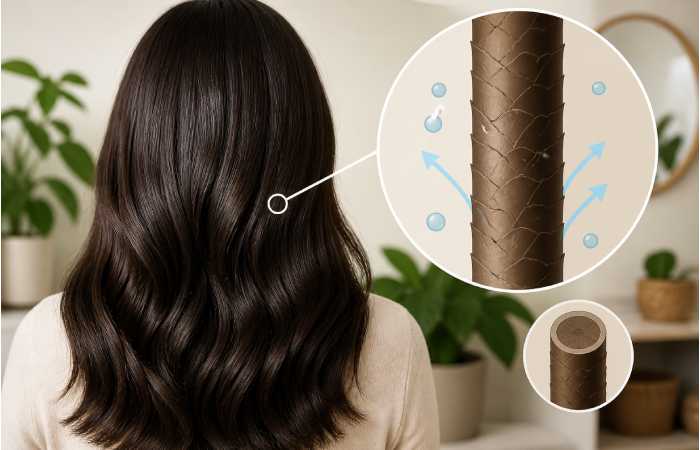
Low Porosity: Low porosity is tightly packed cuticle that will not absorb moisture easily. Although it’s a healthy looking and shiny hair type due to the reflection of light off of the cuticles it may be hard to hydrate.
Common signs of low porosity hair
- Water beads up on the hair instead of sinking in quickly
- Products sit on top of the hair
- Hair takes a long time to get fully wet
- Deep conditioners do not seem to work well
- Hair feels coated, weighed down, or stiff
- Build-up appears fast, especially with creams and oils
The challenge is not that low porosity hair does not need moisture. It does. The challenge is that buildup can block moisture from entering in the first place.
What Does a Clarifying Shampoo Do?
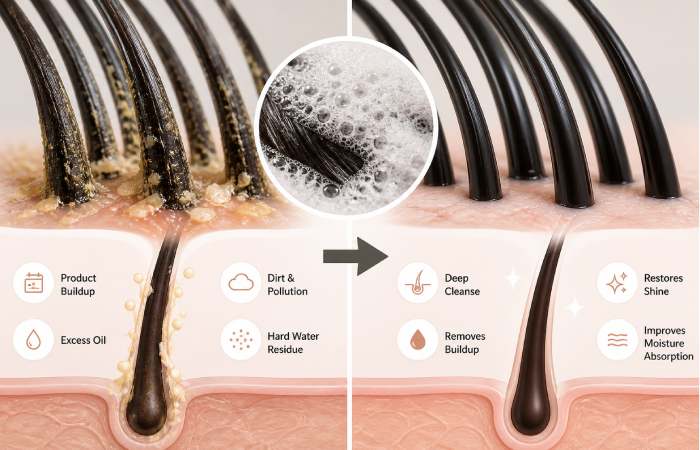
Clarifying shampoo takes off any products and buildup off of your hair that normal shampoo can’t. Some products and residues that it can wash away include heavy oils, silicones
- gels and mousses
- hard water minerals
- sweat and pollution residue
- leftover conditioner or leave-in products
This is ideal for low porosity hair because it seems like residue clings more to the outside of your strands and makes your hair feel coated. When you clarify your hair the result is usually a very lightweight and airy feel. Conditioner readily attaches to it. A clarifying shampoo should not be used in every wash. It is not a daily shampoo but a reset button for hair.
Why Low Porosity Hair Needs Clarifying
Low porosity hair can look healthy while quietly collecting product residue. Since the cuticle resists opening, buildup sits on the surface longer than it does on other hair types. That can create several issues:
- Conditioners stop working well
- The scalp feels greasy too quickly
- Curls lose bounce
- Hair gets dull or sticky
- Moisture treatments seem ineffective
Clarifying shampoo clears that layer so your next moisturizing routine can actually reach the hair properly.
Comparison Table: Best Clarifying Shampoo Types for Low Porosity Hair
| Clarifying Type | Best For | How Often to Use | Main Benefit | Possible Downside |
| Gentle clarifying shampoo | Regular buildup, mild residue | Every 2–4 weeks | Cleans without being too harsh | May not remove heavy buildup |
| Strong clarifying shampoo | Heavy oils, silicone, styling product overload | Once every 3–6 weeks | Deep reset for coated hair | Can feel stripping if overused |
| Chelating shampoo | Calcifications and mineral residue | When required especially in hard water areas, | The mineral build-up which a regular shampoo might not always get rid of | Can be drying if used too often |
| ACV based clarifying shampoo | Light accumulation & a fresh scalp | Occasionally | Can refresh your scalp and hair. | Occasionally, the strength is insufficient for heavy build-up. |
| Sulfate-free clarifier | Sensitive scalp, light buildup | Every 2–4 weeks | More gentle cleansing | Less effective on stubborn residue |
In addition to this simple guideline, there are different types of clarifiers to pick based on what your hair really requires as opposed to what sounds “strong.”
Selecting the right clarifying shampoo for low porosity hair
The right clarifying shampoo can remove buildup without making the hair brittle and dry like straw and is selected based on the amount of buildup on the hair and the hair’s sensitivity.
Look for these helpful features
- Good cleansing agents that remove residue well
- Chelating ingredients if you have hard water
- Balanced formula that does not leave the hair overly rough
- Lightweight finish so the hair feels clean but not stripped
Be cautious with these
- Too many heavy moisturizing oils in a clarifying product
- Very rich formulas that are more cleansing conditioners than actual clarifiers
- Using a strong clarifier every wash day
- Skipping conditioner after clarifying
Low porosity hair usually responds best when the wash is thorough but the follow-up conditioning is equally intentional.
Ingredients That Help
You do not need a chemistry degree to shop smart. A few ingredient clues can help.
Good clarifying ingredients
- Sodium C14-16 Olefin Sulfonate-A harsh cleaner. Usually used in clarifying shampoos.
- Sodium Lauryl Sulfate/ Sodium Laureth Sulfate-Great at lifting heavy build-up.
- Disodium EDTA/ Tetrasodium EDTA-Can help remove minerals from hard water.
- Citric Acid: can help with scalp freshness and product balance
- Apple Cider Vinegar: sometimes used for light clarifying and shine
Ingredients that may soften the cleansing feel
- Aloe
- Light humectants
- Small amounts of conditioning agents
- Balanced pH formulas
For low porosity hair, the best clarifying shampoo is often one that cleans well but does not leave too much residue behind.
How Often Should You Clarify Low Porosity Hair?
There is no single rule for everyone, but a useful starting point is:
| Hair Routine | Clarifying Frequency |
| Light product use | Every 3–4 weeks |
| Regular gel/cream use | Every 2–3 weeks |
| Heavy oils, butters, or stylers | Every 1–2 weeks |
| Hard water exposure | As needed, sometimes weekly in severe cases |
The more products you use the more frequently you might need to clarify, but remember, always let your scalp and hair dictates the schedule, once hair feel squeaky, rough or tangled after clarification, you should minimize your clarifying.
How to use clarifying shampoo on low porosity hair correctly
Clarifying, the best effect can be achieved when the process is thoughtful.
Simple wash routine
- Soak hair thoroughly.
- Hair of low porosity may not absorb water easily, so allow the hair to be fully saturated for some extra time.
- Start the clarifying shampoo application on the scalp.
- This area will build up with the most residue, and concentrate the product where it is most needed.
- Let the lather move through the lengths gently
Do not scrub the ends aggressively.
- Rinse extremely thoroughly: It’s easy for shampoo residue to leave you with a dry, coated feel.
- Condition with a moisturizing conditioner or deep conditioner: this is an absolute must after clarifying as it opens the hair cuticles to accept moisture.
- Use heat or steam with conditioner: Low porosity hair loves the heat from this. Clarifying without rehydrating is like cleaning a room and never putting anything back in order.
The result may feel neat at first, but not comfortable for long.
What to Expect After Clarifying?
After a proper clarifying wash, low porosity hair often feels:
- lighter
- cleaner at the scalp
- less sticky or coated
- more receptive to conditioner
- bouncier and more defined
At the same time, the hair may feel slightly rough before conditioning. That is normal if the shampoo is strong. The post-wash moisture step usually makes the biggest difference.
Mistakes to Avoid
Low porosity hair is easy to over-handle when people mistake buildup for dryness.
Common mistakes
- clarifying too often
- using heavy oils right after washing and causing buildup again
- skipping conditioner after clarifying
- using too much product during styling
- ignoring hard water as a source of residue
- choosing a shampoo that is too mild to actually do the job
A smart hair routine is not about using more products. It is about using the right ones at the right time.
Sample Comparison Table: Which Clarifier Fits Your Hair Best?
| Hair Concern | Best Clarifying Choice | Why It Helps |
| Hair feels coated and heavy | Strong clarifying shampoo | Removes residue quickly |
| Hair is dull from minerals | Chelating shampoo | Targets hard water deposits |
| Scalp is oily but hair is sensitive | Gentle clarifying shampoo | Cleans while reducing harshness |
| Hair has light product buildup | Sulfate-free clarifier | Keeps cleansing balanced |
| Hair feels flat after styling products | Deep clarifying shampoo | Restores bounce and movement |
This kind of matching is often more useful than chasing the “best” shampoo in a general sense. The right shampoo depends on what is actually sitting on your hair.
A Simple Routine for Low Porosity Hair in the USA
In the USA a lot of people can find their hair is affected by weather, indoors heated air, dampness, hard water etc. A routine could go something like:
- mild shampoo most wash days
- clarifying shampoo every 2–4 weeks
- deep conditioner after every clarifying session
- occasional heat or steam during conditioning
- lightweight styling products to reduce buildup
If you have hard water chelating shampoo could be very useful. In drier climates, it’s probably essential to pamper low-porosity hair that has just been clarified because it’s really prone to feeling rigid.
Final Thoughts
The least appreciated staple product for low porosity hair is arguably the clarifying shampoo. The proper use of a clarifying shampoo helps to strip away all that has been accumulated and preventing moisture from getting in, while stimulating the scalp and allowing your conditioners to actually do what they need to do. The important key is to Clarify with Intent not out of obligation.
Low porosity hair is not going to benefit from excessive layers upon layers of rich products. Low porosity hair requires a clean slate, a gentle yet structured moisturizing technique, and a washing regimen that honors its strong cuticle.