

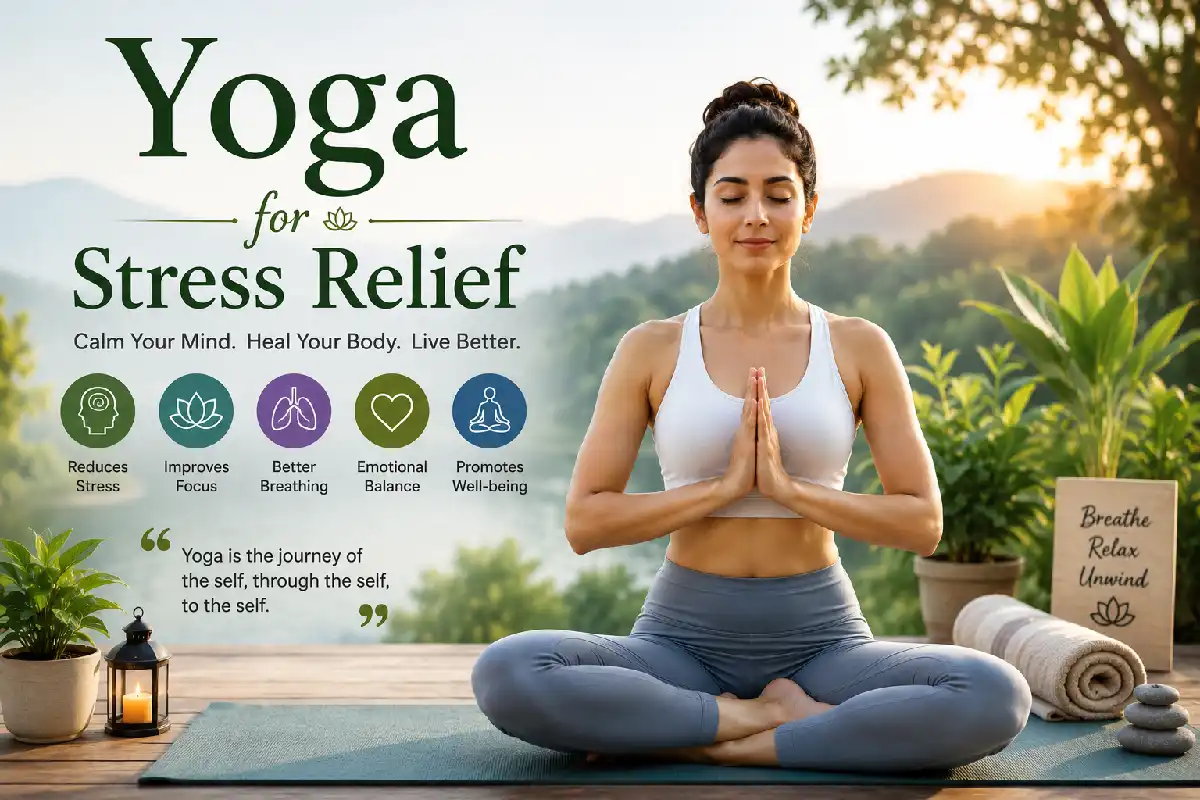
Yoga for Stress Relief: Complete Guide to Relaxation, Mental Wellness and Better Sleep
 Khizrana Begum
Beauty & Lifestyle Writer
Khizrana Begum writes clear and reader-friendly content covering beauty, lifestyle and related topics.
Read Full Bio of Author →
Khizrana Begum
Beauty & Lifestyle Writer
Khizrana Begum writes clear and reader-friendly content covering beauty, lifestyle and related topics.
Read Full Bio of Author →
 Sameena Begum
Health, Technology & Digital Content Reviewer
Sameena Begum reviews content for clarity, accuracy and overall reader usefulness.
Read Full Bio of Reviewer →
Sameena Begum
Health, Technology & Digital Content Reviewer
Sameena Begum reviews content for clarity, accuracy and overall reader usefulness.
Read Full Bio of Reviewer →
Yoga for Stress Relief: We all know stress. In this day and age it’s almost impossible to escape it. Juggling work demands, family obligations, financial concerns, and constant digital alerts seems to be the new normal, which means that the our nervous systems rarely get an opportunity to fully reset.
Luckily, there’s a time-tested practice, proven by science, that you can use to interrupt the stress cycle: yoga.
Practicing these yoga poses for stress relief can help calm your mind and relax your body.
It integrates physical movement, breath awareness and mindful contemplation to provide a complete body and mind rest. Read on for everything you need to know about stress-relief yoga – the science, specific practices and a beginner’s yoga routine.
❝
This article is a part of
Stress Management Guide
What is Yoga for Stress Relief?
Yoga for stress relief is the therapeutic approach to yoga through the use of asana, pranayama, and dhyana, the posturing, breathing and meditation aspects of the yoga tradition to help pacify the nervous system, cultivate inner serenity and not a sense of power, prowess or flexibility. Yoga for stress relief also includes an attitude of introspection and passive absorption.
Ultimately, any one of these practices can encourage your body to transition from a state of stressed flight-or-fight mode to a state of rest and restore. While some types of strenuous workouts can temporarily spike your body’s cortisol levels (before causing them to drop significantly lower later), yoga is designed to foster ongoing, balanced cortisol reductions by engaging your innate relaxation response.
Add these yoga exercises for stress relief to your routine to improve flexibility and reduce daily tension.
No matter how old, fit or experienced (or inexperienced!) you are, you can use this style of yoga for stress reduction.
Who Can Benefit From Stress-Relief Yoga?
| Group | How Yoga Helps |
| Office workers | Relieves tension from prolonged sitting and screen time; reduces mental fatigue |
| Students | Improves focus and reduces exam-related anxiety |
| Parents/caregivers | Provides a short mental reset amid demanding schedules |
| Shift workers | Helps regulate disrupted sleep-wake cycles |
| Older adults | Gentle movement supports joint health and emotional balance |
| People with anxiety or mild depression | Complements therapy by calming the nervous system |
How Yoga Helps Reduce Stress?
Yoga’s 5 Stress-Reducing Ways – Science Explains How Many of the benefits of yoga are well-known by those who practice regularly: reducing tension, enhancing muscle tone, building balance and flexibility, promoting mental focus and calm. Yoga can also decrease your levels of stress. However, just how does the physical, and psychological practices behind this type of exercise lower your body’s stress response?
The Science Behind Yoga and Mental Wellness
If you’re new to yoga, start with this beginner’s guide to yoga for stress relief for simple, effective practices.
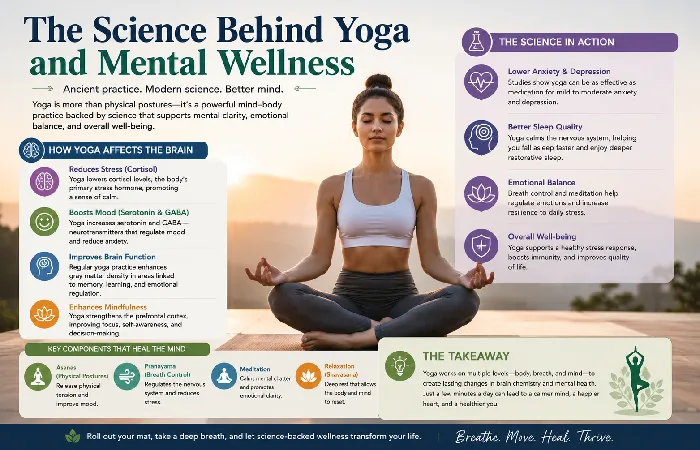
1.Turning on Your Parasympathetic Nervous System
When you are experiencing chronic stress, your body will always default to a “fight-or-flight” response, or in other words, sympathetic nervous system activation. The action of the slow movements and breath work that is characteristic of yoga can trigger the activation of your parasympathetic nervous system or your “rest-and-digest” system.In doing so, your body begins to relax, bringing down heart rate, blood pressure, and muscle tone.
2. Decrease the Cortisol
In situations when the body’s ‘fight-or-flight’ mechanism is on an endless alert the’fight or flight’ hormones too. And when, day-long levels of cortisol- the chief stress hormone in the body are high, they affect sleep, increase belly fat, compromise your immune system and induce anxiety. A recent study found that as little as a 30-minute daily practice can help to decrease baseline cortisol.
3. Releasing tension in the body
The physical stress that we hold in our bodies can affect anything from the shoulder blades to the lower back. It can also affect our chewing and breathing patterns. Yoga postures encourage a sense of letting go in tense parts of the body and this translates back to the brain in the form of calm.
Begin your day with a morning yoga routine for stress relief to boost energy and improve focus.
4.Increasing emotional regulation
The very practice of staying focused and present throughout yoga class helps you to increase your emotional regulation. Mindfulness practices will give you the opportunity to identify and notice how thoughts and feelings come up and pass, teaching your mind how to create a natural pause between stimulating triggers and the urge to react to them.
5. Promoting better sleep
when your mind has been working overtime, it can be difficult to “shut off” the brain when it’s time to fall asleep. Yoga practice encourages deep, steady breathing which not only calms down the nervous system, but also can reduce the chatter that goes on in a stressed mind.
Gentle restorative yoga for stress relief is ideal for deep relaxation and emotional balance.
This ease of falling asleep can have a ripple effect that helps to prevent the stress and sleep cycle from exacerbating itself. Yoga Is Much More Than a Wellness Trend. Scientists confirm that yoga can significantly affect stress and other aspects of your mental health.
Recent studies utilizing biomarkers, brain imaging and questionnaires have already established evidence of how your body and mind can benefit from this practice.
Key Research Findings
| Study Focus | Finding |
| Cortisol levels | Regular yoga practice is associated with lower salivary and blood cortisol levels |
| Heart rate variability (HRV) | Yoga practitioners show improved HRV, a marker of good stress resilience |
| Brain imaging (fMRI) | Increased activity in the prefrontal cortex, linked to emotional regulation |
| GABA levels | Yoga has been linked to increased GABA, a neurotransmitter that promotes calm |
| Anxiety disorders | Yoga-based interventions show reductions in generalized anxiety symptoms |
| Sleep quality | Participants report falling asleep faster and experiencing fewer nighttime awakenings |
| Workplace stress | Employees practicing yoga report lower burnout and higher job satisfaction |
Your Guide to Stress-Relieving Yogaposes
When you feel your shoulders creeping towards your ears and your stomach churning into a tight knot, your mind may race. You feel stressed. Yoga, however, can help us get in touch with our nervous system and tell the part of our brain controlling stress to take a break.
Unwind before bedtime with yoga for better sleep and stress relief to encourage restful, restorative sleep.
Here’s how, plus some helpful yoga practices to add to your routine.
How does yoga help us relax?
The Vagus Nerve It helps with calming the nervous system and runs from your brain stem down into your belly to controls the whole system – heart rate, digestion, how our bodies cope with stress. It’s understood that the practice of yoga-specifically, diaphragmatic breathing, and slow twists-helps to activate this nerve.
It puts our body at ease a bit quicker from “stress mode”.
1) Mind Body Connection – Because yoga helps the body reconnect mind to body, a slow-burn yoga class actually puts our brains at ease and is more beneficial than even aerobic work out (no physical strain needed) for controlling the blues and stress.
Best Yoga Poses for stress relief
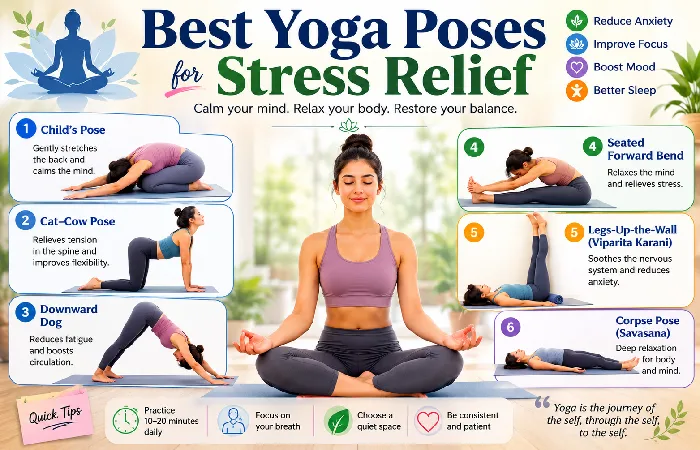
Easy to manage for anyone and with an almost-guaranteed calming impact on the nervous system:
| Pose (English) | Sanskrit Name | Primary Benefit | Hold Time |
| Child’s Pose | Balasana | Calms the mind, releases lower back tension | 1–3 minutes |
| Cat-Cow Stretch | Marjaryasana-Bitilasana | Loosens spine, synchronizes breath and movement | 1–2 minutes |
| Legs-Up-The-Wall | Viparita Karani | Reduces anxiety, relieves tired legs | 5–10 minutes |
| Seated Forward Fold | Paschimottanasana | Soothes nervous system, stretches hamstrings | 1–2 minutes |
| Standing Forward Fold | Uttanasana | Releases tension in neck and shoulders | 30–60 seconds |
| Corpse Pose | Savasana | Deep relaxation, full nervous system reset | 5–10 minutes |
| Reclining Bound Angle | Supta Baddha Konasana | Opens hips, encourages slow breathing | 3–5 minutes |
| Bridge Pose | Setu Bandhasana | Relieves mild anxiety and fatigue | 30–60 seconds |
| Easy Pose (seated) | Sukhasana | Grounding posture for meditation and breathwork | 2–5 minutes |
| Thread the Needle | Parsva Balasana | Releases tension in shoulders and upper back | 1 minute per side |
POSE spotlight: Child’s pose (Balasana A popular, even everyone’s most loved, Child’s pose is the king of all the rest positions!
How to perform it:
1. Take to your knees on the mat with your big toes meeting and your knees spread out a little further than hip distance apart if that’s comfortable
2. Come back onto your heels and lay torso forward over thighs. Extend your arms forward, or let them lie along the side of your body.
3. Bring your forehead back to your mat. Rest here and allow breath to expand into your back and sides.
4. Hold for 1-3 minutes breathing slow and deep into your back and sides.You can do this at any time when stress begins to bubble up – anywhere during a practice, or even completely outside of a class.
Pose Spotlight: Legs-Up-The-Wall (Viparita Karani) If anxious thoughts and tired, heavy legs plague you, this simple inversion is the answer.
How to do it:
- Sit in front of a wall with one side of your body touching the wall.
Then, swing your legs up the wall as you lie down with your back flat on the floor.
2. Walk your hips up to the wall as much as you can (you don’t have to touch it perfectly).
Let your legs rest perpendicular to the ground on the wall.
3. Extend your arms outward, allowing palms to point skyward. Try this breathing method for calming an anxious mind: Close your eyes, breathe deep, expansive breaths for 5-10 minutes.
Breathing Techniques to Calm the Mind
In my experience, pranayama (yogic breathing), individually or integrated into your yoga class, yoga sequence, is one of the quickest and most powerful tools to soothe an anxious mind.
The breath is our one autonomic nervous system process we can consciously alter, allowing for a direct link to how our systems deal with stress.
| Technique | Sanskrit Name | How It Works | Best Used For |
| Diaphragmatic Breathing | Deergha Swasam | Deep belly breathing to activate relaxation response | General stress, anytime |
| Alternate Nostril Breathing | Nadi Shodhana | Balances left/right brain activity, calms nerves | Pre-sleep, anxiety |
| Ocean Breath | Ujjayi | Slight throat constriction creates soothing sound | During yoga practice |
| 4-7-8 Breathing | — | Inhale 4s, hold 7s, exhale 8s to slow heart rate | Panic, racing thoughts |
| Humming Bee Breath | Bhramari | Vibration and sound reduce mental agitation | Anxiety, tension headaches |
| Cooling Breath | Sitali | Cools body and mind, reduces irritability | Anger, overheating stress |
How to: The 4-7-8 Breath Method
1. Sit or lie in a comfortable position
2. Exhale fully out your mouth.
3.Purse your mouth and take a gentle inhale through your nose for
4. Hold for a count of 7
5. Exhale completely through your mouth, exhaling the sound of air (woosh) on a count of 8.
6. Repeat for 4 rounds.
This is often beneficial to do before bedtime or when you’re experiencing immediate stress.
How to : This can help directly lower your heart rate and engage your “rest and digest” nervous system response. Alternate Nostril Breathing (Nadi Shodhana)
1. Start by sitting cross-legged or on your knees with a long, extended spine.
2. Seal your right nostril with the pad of your right thumb.
3. Slowly inhale through your left nostril.
4. Plug your left nostril with the ring finger, release the thumb and exhale through the right.
5. Slowly inhale through the right nostril.
6. Plug your right nostril with your right thumb and exhhale out of your left nostril. Continue alternate between the nostrils for 5-10 rounds.
Beginner Yoga Routine for Stress Relief
Here is a simple 20 minute beginner friendly routine for stress reduction that anyone can do on the mat or on the floor.
| Step | Pose/Practice | Duration |
| 1 | Seated breathing (deep belly breaths) | 2 minutes |
| 2 | Cat-Cow Stretch | 2 minutes |
| 3 | Child’s Pose | 2 minutes |
| 4 | Standing Forward Fold | 1 minute |
| 5 | Low Lunge (both sides) | 3 minutes |
| 6 | Seated Forward Fold | 2 minutes |
| 7 | Reclining Bound Angle Pose | 3 minutes |
| 8 | Bridge Pose | 1 minute |
| 9 | Legs-Up-The-Wall | 5 minutes |
| 10 | Corpse Pose (Savasana) with 4-7-8 breathing | 5 minutes |
Tips for Getting Started
- Practice on an empty stomach or wait at least an hour after eating.
- Use a quiet, dimly lit space to enhance the calming effect.
- Wear comfortable clothing that doesn’t restrict movement or breathing.
- Don’t force any stretch — mild tension is fine, pain is not.
- Focus on breath first, flexibility second. Stress relief comes more from the breathing and mental focus than from how deep you can stretch.
- Consistency matters more than duration. A daily 10-minute practice often outperforms an occasional 60-minute session.
Common Mistakes to Avoid
Don’t let the potential benefits of stress reduction be wasted by approaching the practice of yoga incorrectly! Many newbies make these subtle (but not so subtle!) mistakes which completely negate the impact.
| Mistake | Why It’s a Problem | Better Approach |
| Rushing through poses | Prevents nervous system from fully downshifting | Slow down, hold poses longer |
| Holding your breath | Increases tension instead of releasing it | Keep breath slow and continuous |
| Comparing yourself to others | Creates performance pressure, defeating the purpose | Focus inward, ignore others’ flexibility |
| Practicing only when already stressed | Misses the preventive, cumulative benefits | Practice regularly, not just in crisis moments |
| Skipping Savasana (final relaxation) | Loses the deep nervous system reset | Always allow 5+ minutes of final rest |
| Using yoga as pure exercise | Overemphasizes physical intensity over calm | Balance strength work with restorative sessions |
| Checking phone during practice | Disrupts mindfulness and re-triggers stress | Keep phone on silent, out of reach |
| Choosing overly advanced poses | Can cause frustration or injury | Start with beginner-friendly, restorative poses |
How Often Should You Practice Yoga?
Commitment and consistency are vital to reaping the stress-relieving benefits of yoga. Fortunately, there’s no such thing as too little yoga-although you should definitely work your way up. According to researchers and experienced yogis alike, this is how often you should be heading to the mat for your sanity:
| Frequency | Expected Benefit |
| 5–10 minutes daily | Noticeable short-term calming effect; good for busy schedules |
| 20–30 minutes, 3–4x per week | Meaningful reduction in baseline stress and improved sleep |
| 45–60 minutes, 3x per week | Significant improvements in mood, flexibility, and resilience |
| Daily practice (any duration) | Strongest cumulative effect on cortisol regulation and anxiety reduction |
Creating a Sustainable Practice
Create a realistic plan. Doing five minutes of practice each day is more manageable – and generally much more effective long term – than the hour a day you commit to and then give up on after one week. Hook it onto an existing habit.
We remember to practice if it falls after you wake up and right before you go to bed.
Journal your practice.
It’ll be a nudge to you that this is a habit you’re creating and can serve to hold you accountable in watching as you start feeling well, starting to sleep. Listen to what you your body needs – sometimes it will want to ease into rest, other times it’ll need to swing through a bit more vigorously.
Neither is wrong as long as the focus is still on deliberate, controlled motion.
Combining Yoga With Other Stress Management Techniques
One yoga session isn’t necessarily a cure-all, however. When partnered with these other practices that also reduce stress, yoga can prove to be much more potent and sustainable:
| Complementary Technique | How It Pairs With Yoga |
| Meditation | Extends the mental calm cultivated during yoga into daily life |
| Journaling | Helps process emotions surfaced during introspective practice |
| Adequate sleep hygiene | Yoga improves sleep quality; good sleep habits reinforce the effect |
| Balanced nutrition | Reduces physical stressors like blood sugar crashes that mimic anxiety |
| Time in nature | Combines yoga’s calming effects with the restorative power of green spaces |
| Limiting screen time | Reduces overstimulation that yoga practice is trying to counteract |
| Social connection | Emotional support complements yoga’s individual, internal work |
| Professional therapy | For chronic or severe stress/anxiety, therapy addresses root causes yoga alone cannot |
A Note on Professional Support
Yoga is an excellent complementary tool for managing everyday stress, but it is not a replacement for professional mental health care. If stress, anxiety, or low mood are significantly interfering with daily life, work, relationships, or physical health, it’s worth speaking with a doctor or licensed therapist. Yoga can be a valuable part of a broader treatment plan, working alongside — not instead of — professional guidance.
Frequently Asked Questions
Can yoga completely eliminate stress?
No single practice can eliminate stress entirely, since some stress is a normal part of life. However, regular yoga practice can significantly reduce the intensity and frequency of stress responses, and improve your ability to recover from stressful events.
How quickly will I feel the benefits?
Many people notice a calming effect after just one session, particularly with breathing exercises and restorative poses. Longer-term benefits — like lower baseline stress and better sleep — typically build over 4–8 weeks of consistent practice.
Do I need to be flexible to start?
Not at all. Flexibility is a result of consistent practice, not a prerequisite. Stress-relief yoga in particular emphasizes gentle stretching and breathing over deep or advanced postures.
What time of day is best for stress-relief yoga?
Morning practice can set a calm tone for the day, while evening practice helps unwind and prepare for sleep. Both are effective — choose whichever fits your schedule and feels most beneficial.
Can yoga help with anxiety as well as everyday stress?
Yes. Many studies show yoga can reduce symptoms of generalized anxiety, though it works best as part of a broader approach that may include therapy, medication (if prescribed), and lifestyle changes for moderate to severe anxiety.
Is it better to do yoga alone or in a class?
Both have benefits. Classes offer structure, accountability, and instructor guidance, which is helpful for beginners. Home practice offers flexibility and privacy, which some people find more relaxing. Many practitioners benefit from a mix of both.
What if I fall asleep during Savasana?
This is common and generally not a concern — it often indicates your body needed the rest. If it happens frequently, it may be worth evaluating your overall sleep quality separately.
Can children or older adults practice stress-relief yoga?
Yes. This style of yoga is gentle and low-impact, making it appropriate for most ages. Older adults or those with joint concerns should consider chair yoga variations, and children can benefit from simplified versions focused on breathing and play-based movement.
Conclusion
Yoga for stress relief is far more than a passing wellness trend — it’s a practical, evidence-backed toolkit for calming the nervous system, improving emotional regulation, and reclaiming a sense of control in a chaotic world. Through a thoughtful combination of gentle postures, mindful breathing, and present-moment awareness, yoga offers a direct pathway to reducing cortisol, improving sleep, and building long-term resilience against everyday pressures.
The beauty of this practice lies in its accessibility. You don’t need advanced flexibility, expensive equipment, or hours of free time to benefit — just a few consistent minutes a day, a willingness to breathe deeply, and the intention to slow down. Whether you’re dealing with the low hum of daily stress or more acute anxiety, yoga provides tools you can return to again and again, on the mat and off.
Start small, stay consistent, and let your practice grow naturally. Over time, you may find that the calm you cultivate during your yoga sessions begins to show up in the rest of your life, too — in how you respond to challenges, how well you sleep, and how present you feel in each moment.