

Women’s Clothing: A Complete Guide to Styles, Essentials, and Everyday Fashion
 Khizrana Begum
Beauty & Lifestyle Writer
Khizrana Begum writes clear and reader-friendly content covering beauty, lifestyle and related topics.
Read Full Bio of Author →
Khizrana Begum
Beauty & Lifestyle Writer
Khizrana Begum writes clear and reader-friendly content covering beauty, lifestyle and related topics.
Read Full Bio of Author →
 Sameena Begum
Health, Technology & Digital Content Reviewer
Sameena Begum reviews content for clarity, accuracy and overall reader usefulness.
Read Full Bio of Reviewer →
Sameena Begum
Health, Technology & Digital Content Reviewer
Sameena Begum reviews content for clarity, accuracy and overall reader usefulness.
Read Full Bio of Reviewer →
Women’s Clothing: Women’s dressing, in my opinion, is far more than what she actually wears. A woman can wear something that can make the day not normal, but rather a dream; the woman can be encouraged to cope with the long and stressful working hours; the woman can just show the world that she is ‘ME’. Be it the amazing shirt teamed with the smartest denim or an outstanding dress, the choices women have for their ethic wear have no end at all.
Obviously, all ladies will have different preferences for clothes and wear them their own way: some will opt for classic fundamental trends, while others can enjoy some play with colors, printed motifs, shapes and silhouettes, and trends of the season.
❝
This article is a part of
Women’s Fashion Guide
What are the Different Types of Women’s Clothing?
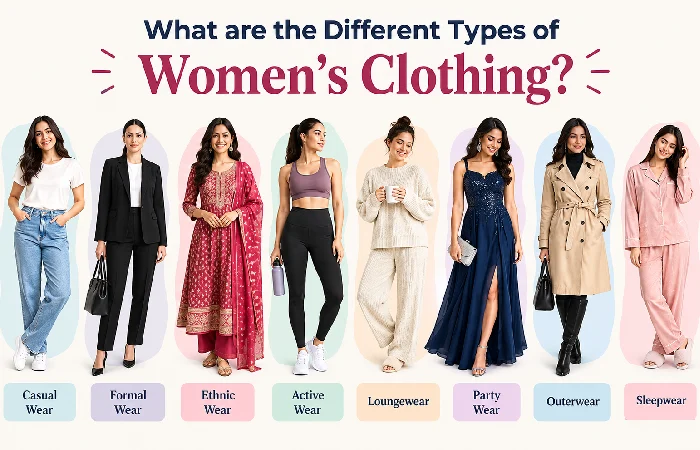
Choosing the right clothing becomes easier when you understand different styles, fits, and options for everyday and special occasions. Explore our complete women’s fashion guide for broader style inspiration.
Women’s clothes can be divided into three categories according to occasions, purposes, and fabrics. Comfort and functionality are the basic requirements of casual wear, while business wears/ formal wears and special outfits are suitable for occasions. Ethnic wear embodies cultural identification, which permits you much more personal freedom.
Some common categories include:
| Clothing Type | Best Suited For | Popular Examples |
| Casual wear | Everyday activities | T-shirts, jeans, casual dresses |
| Formal wear | Work and professional events | Blazers, trousers, formal dresses |
| Party wear | Celebrations | Gowns, embellished dresses |
| Traditional wear | Cultural occasions | Sarees, salwar suits, lehengas |
| Activewear | Exercise and sports | Leggings, sports tops |
| Loungewear | Relaxing at home | Joggers, soft sets |
A well-rounded wardrobe usually includes a mixture of these categories, allowing you to dress appropriately without constantly buying new clothes.
Essential Clothing for Women
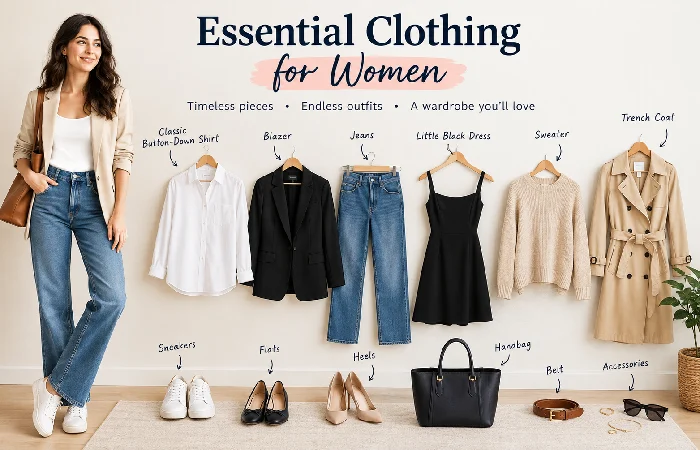
Creating versatile looks starts with combining clothing pieces that suit your personal style, lifestyle, and occasion. Explore our women’s fashion outfit ideas for practical inspiration.
Starting with a basic wardrobe is actually simpler since basic items in the wardrobe are usually worn several times and in various ways. Useful items can be a pair of comfy jeans, basic neutral pants, T-shirts in neutral colors, a generic top, a dress with a simple silhouette, a cardigan/jacket, and some smart, comfy wear. Depending on your work style and lifestyle, you may need to own a blazer, ethnic wear, gym wear, multi-layered jacket/sweater.
Neutral colors, for example black, white, navy blue, beige, gray, and denim, are all easy to match with any color when you are picking them.
Please remember that clothes should not only comprise trendy items, but everyday comfy wear is always essential.
Casual Clothing for Women
In fact, casual wear is produced for our convenient and stylish daily life, used for shopping, seeing friends, traveling, running some private tasks, or the weekend.
Casual wear generally involves T-shirts, jeans, cotton dresses, casual pants, wide shirts, leggings, skirts, and trainers…
The commonly used materials are Cotton, linen, jersey, and soft blending materials, and so on, as they are comfortable for a long day!
Formal Clothing for Women
Formal clothing is all about achieving a refined style, which may be best suited to work in a professional environment or for interviews and ceremonies. Whether it’s an obligation or not depends on when and where it needs to be worn. In classic formality, the range could consist of: fitted tailored trousers, pencil skirts, formal blouses, formal blazers, formal dresses, and sophisticated shoes.
| Formal Piece | Styling Idea |
| Blazer | Pair with trousers or a skirt |
| Formal trousers | Wear with a blouse or shirt. |
| Pencil skirt | Combine with a tucked-in top. |
| Formal dress | Add simple jewelry and heels. |
| Blouse | Pair with tailored bottoms |
For formal wear, fit is actually more important. Even the cheapest outfit can appear classy when the shoulder, the sleeve, the waist, and the pant length are the right fit.
Dresses for Women
Ladies’ dresses are one of the most versatile clothes in women’s clothing now. Beautiful dresses can be smart, casual, party-loving, dreamy & extremely glamorous- this is actually only based on what kind of dresses ladies are choosing for the occasion. The most fashionable ones that can be chosen are maxi, midi, shirt-style dresses, wrap dresses, bodycon, A-line, party cocktail dresses, and elaborate evening gowns.
For day dresses, ladies should choose dresses made of easy, breezy fabric in a loose fit; to attend any celebrations or parties, ladies will choose one from expensive fashion, which is made of fine fabrics or has decorations in order to make others look at it.
Professional settings often call for clothing that balances comfort, style, and a polished appearance. Explore our women’s workwear fashion guide for helpful outfit ideas.
The most important thing when buying a dress is the occasion you wish to wear it at, as a wonderful outfit that is not fit for the occasion is a wasted dress.
Tops and Blouses for Women
The simplest and most changeable item of clothing can be a top. The bottom can be as casual as a T-shirt style but elegant with a structured shirt.
You’d mostly wear T-shirts as informal wear, button-down shirts and structured blouses as office wear, but it also helps to include crop tops, tunic tops, peplum tops, camisoles, polo shirts, and knit tops, etc.
The kind of neckline, sleeve length, fabric, and fit you wear greatly varies and changes the complete look.
Pants and Jeans for Women
Pants and jeans form the foundation of many modern wardrobes. They are practical, easy to style, and available in numerous silhouettes.
Common styles include:
- Straight-leg jeans
- Skinny jeans
- Wide-leg jeans
- Bootcut jeans
- High-waisted trousers
- Wide-leg trousers
- Cigarette pants
- Palazzo pants
- Relaxed-fit pants
It all depends on what you feel good in. High waists define the waist, and wide legs feel retro and on-trend, whereas straight jeans are versatile for a smarter or more casual look with sneakers.
Skirts and Shorts for Women
Both skirts and shorts contribute to a diverse wardrobe and are particularly appropriate when it’s warmer. In the case of skirts, they can come in a huge variety of shapes and sizes; ‘mini’, ‘midi’ and ‘maxi’ are all distinct lengths, and shapes range from tight ‘pencil’ skirts to loose ‘pleated’ or ‘A-line’ styles.
Similar variety is on offer when buying shorts. Shorts can come in a range from casual ‘denim’ shorts to a more tailored ‘chino’ style or an easy-to-wear ‘linen’ short or sporty design.
As a guideline, the rule of proportions is worth bearing in mind when planning outfits. A tight top might suit a fuller skirt, while a looser top might be more wearable over something tailored.
Traditional Clothing for Women
As an aspect of women’s dressing, it is integral since it blends clothes with culture, history, skill, and celebration. So a woman could don Indian attire, i.e., a saree, a salwar kameez, a lehenga, an Anarkali suit, a kurta, or regionally woven attire, on festivals, ceremonies, religious festivals, and family ceremonies.
For celebrations and social occasions, choosing the right clothing can help you create an elegant and stylish look. Explore our women’s party wear fashion guide for useful inspiration.
Such attire could be subtle or elaborate, befitting the occasion in either case.
However, handspun, embroidery, printing techniques, zardozi, and various regionally woven styles are unique. These can further be accessorized with traditional wear. Often, elements of traditional clothes are incorporated into modern ones, such as a traditional kurti with a pair of jeans or even a modern-styled blouse with a saree.
How to Choose the Right Women’s Clothing?
Choosing clothing becomes easier when you look beyond trends. Start by considering comfort, occasion, fit, fabric, color, and personal style.
Ask yourself a few simple questions before buying something:
-
- Where will I wear it?
An office outfit and a weekend outfit may require very different designs. - Does it fit comfortably?
Clothing should allow natural movement rather than making you constantly adjust it. - Does the fabric suit the weather?
Cotton and linen can be excellent choices for warm climates, while wool and heavier fabrics provide warmth in colder conditions. - Can I style it in different ways?
Versatile pieces generally provide greater value. - Does it feel like me?
Personal style matters more than blindly following every fashion trend.
- Where will I wear it?
Fashion should include comfortable and stylish choices for different body shapes and sizes. Explore our plus-size women’s fashion guide for helpful styling inspiration.
A functional wardrobe is, in the end, a mixture of both style and comfort. Try not to accumulate pieces you never wear; on the contrary, try to create clothing that will easily go together and can take its place in your day.
Active lifestyles require clothing that provides comfort and allows easy movement while still reflecting your personal style. Explore our women’s activewear fashion guide for practical ideas.
Final Thoughts
Women’s clothes come in such varieties that you will be able to fulfill the different kinds of expressions required to feel good. From casual wear to formal dresses and from elaborate traditional outfits to simple classic creations, every aspect has its use. A style-savvy person is not the person who owns a wide variety. Instead, if you know what you possess, what to wear with which attire, and you are confident wearing it, you achieve mastery. A harmony of ease, size, and taste helps achieve comfort; dressing up is then a pleasure instead of a pain.